Finding Moses Williams: a virtual program, 19 Nov. 2025

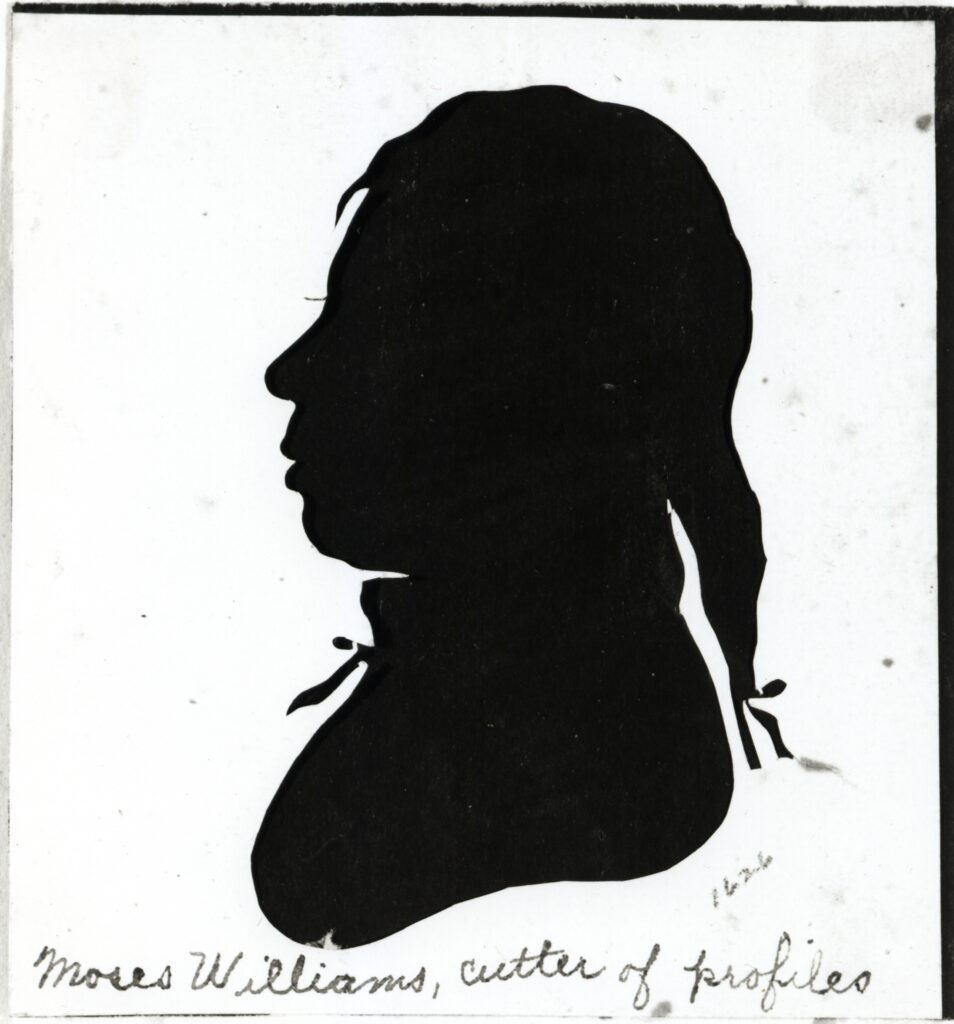
silhouette of Moses Williams, about 1802

Thrilled to announce i’ll be presenting along with four other speakers at an upcoming virtual program. The Library Company of Philadelphia’s Program in African American History and the Center for American Art at the Philadelphia Art Museum are sponsoring the event.

My twenty minute talk, “Not Yet Completely Free: Gradual Emancipation and the Family of Moses Williams, Philadelphia, 1776-1830.” presents the results of an archival journey. While I searched for information on Moses Williams, I instead found indentures in the Pennsylvania Abolition Society Papers for his family members that let me reconstruct his family tree. These records show how a Free Black family navigated a difficult economy in the decades before the 1838 census.

This talk draws on my article which appeared in volume 43 of the AAHGS Journal. The Sons and Daughters of the US Middle Passage awarded me the Phillis Wheatley Literary Award this past June for the article.
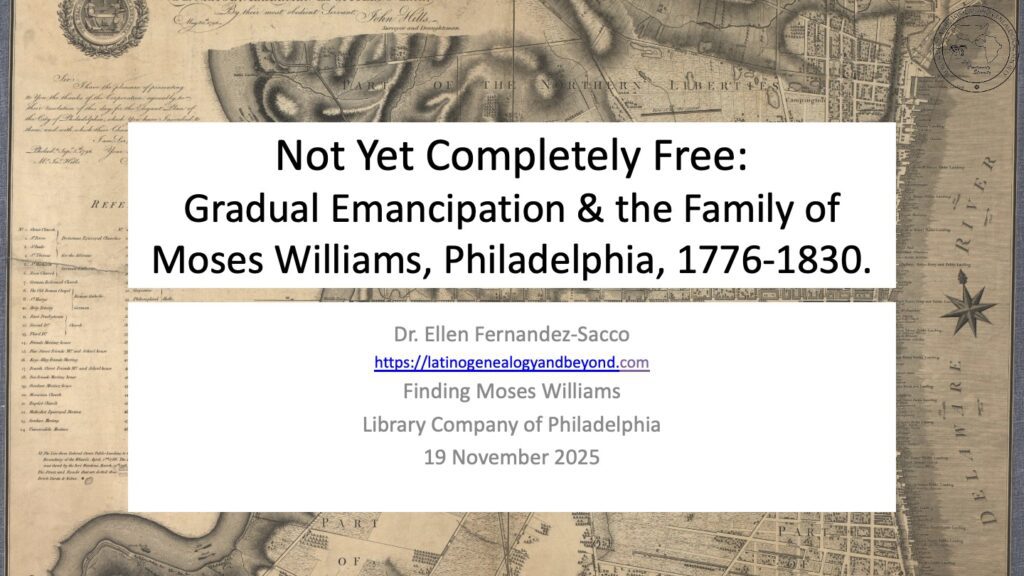
title slide, Not Yet Completely Free
title slide, Not Yet Completely Free,

Finding Moses Williams: the program

The other presenters are Carol Soltis, Nancy Proctor, Dean Krimmel, & Lauren Mulvey with an introduction by Sarah J. Weatherwax, Senior Curator, Library Company. Appreciate the knowledge shared & discussed over the preceding months with artists and scholars whose work focuses on Moses Williams. There is much to learn about Williams life, art and family.

Please register at the link below the program description:

profile of Moses Williams ca 1802

Finding Moses Williams

Free Virtual Program

November 19th , 2025 at 1 PM ET

This program of illustrated talks by five speakers focuses on the identification of the exceptional hollow-cut paper profiles created by Moses Williams (1776-1830) at Peale’s Philadelphia Museum and on presenting new historically accurate information about Williams’s life and family. Moses’s parents were manumitted by Peale in 1786 and Moses, who was born enslaved, was then indentured to Peale by his parents until age twenty-eight

Raised within the Peale family, Moses was literate and trained in skills for creating and installing the Museum’s displays of art and natural science. After the installation of a physiognotrace device for creating hollow-cut paper profiles in 1802, Moses was freed and given the concession to operate this new attraction. The popularity of this inexpensive form of portraiture and the highly accurate and elegant profiles Moses cut, made him financially independent.

Recent research into Moses’s life provides us with a clearer understanding of his artistry and other activities, as well as his death date and the identity of his descendants. And, the story of Williams’s birth family illuminates how the practice of indenture used by Free Black families, like the Williams family, was a strategy for seeking financial stability.

A small selection of Moses Williams’s profiles will be on display at the Library Company during November and December and in the Peale Gallery at the Philadelphia Museum of Art.

REGISTER HERE

This program is sponsored by the Library Company of Philadelphia’s Program in African American History and the Center for American Art at the Philadelphia Museum of Art.
Restoring the Legacy of Moses Williams: A Case Study of Emancipation

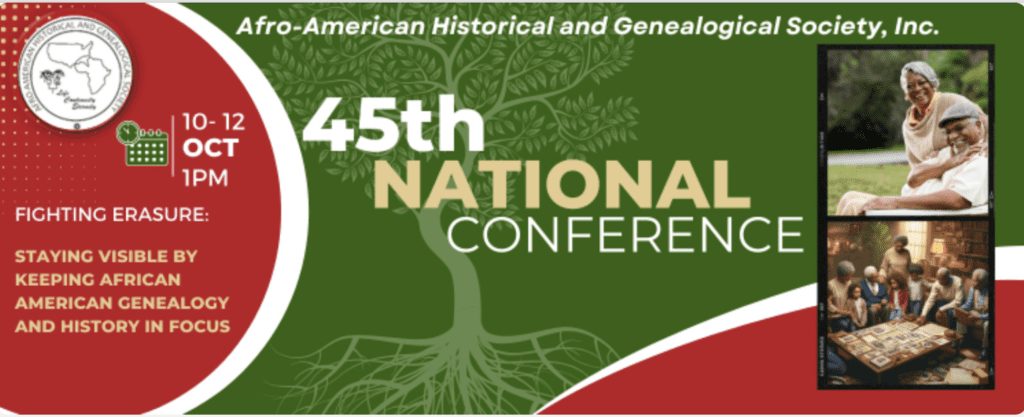
AAHGS 45th National Conference banner

Thrilled to announce that my presentation proposal, “Not Yet Completely Free: Gradual Emancipation and the Family of Moses Williams, Philadelphia, 1776-1833.” was accepted for the 45th AAHGS National Conference this October!  Appreciate the opportunity to share, learn and contact other genealogists and family historians at this wonderful event, hosted by AAHGS President LaJoy Mosby. 

The conference theme is “Fighting Erasure: Staying Visible by Keeping African American Genealogy and History in Focus.” This centers on the “role of preserving and spotlighting African American history and genealogy in the broader narrative of American history.” 

Silhouette of Moses Williams, Cutter of Profiles, 1802
Silhouette of “Moses Williams, Cutter of Profiles, 1802″Library Company of Philadelphia.

Here’s my abstract for my presentation, “Not Yet Completely Free: Gradual Emancipation and the Family of Moses Williams, Philadelphia, 1776-1833.” :

When the word slavery comes to mind, many think of the US South, rather than the Northern states. Northern slavery’s history is less well known, particularly in states with gradual emancipation—Pennsylvania, New York, New Jersey, Connecticut. This presentation focuses on the family histories tied to the silhouette artist and museum artisan Moses Williams (1776-ca 1833), to glimpse African descended, Free People of Color and the challenges faced in their process of emancipation. The reality of bondage challenges the image of Philadelphia, a city so closely identified with national freedom. Important clues for Moses Williams and his family are contained in archives that includes the Pennsylvania Abolition Society, and records for his former enslaver, the Maryland-born portrait painter and Philadelphia-museum owner Charles Willson Peale (1746-1823). Peale held Williams’ parents between 1776-1786, and freed Williams in 1803. Most archival material on the Williams family is excavated from the Papers of the Peale Family, newspapers, deeds & census records. While the origins of Williams parents remain a question, records suggest the situations that Free Black Philadelphians contended with under the 1780 act for Gradual Abolition. Freedom was negotiated and paid for with terms of service at a tender age. This case study shows how the increased availability of digitized records and community research helps restore the experiences of free Black families to a larger historical narrative. 

My deep thanks to Nancy Proctor and Dean Krimmel of The Peale Baltimore, who have invited me to share my work on Moses Williams, who now has a museum space and internship program named after him; and to Carol Soltis, of the Philadelphia Museum of Art, who is currently studying Williams’ technique and style for the profiles he produced, that numbered nearly nine thousand. Williams’ family members experienced degrees of unfreedom in different ways, and I seek to acknowledge their resilience by considering the ways they sought freedom at the cusp of the nineteenth century.