I’ve started a brief birthday fundraiser for PROPA, the Puerto Rican Organization for the Performing Arts based in Orlando, Florida. This is a first for me, that celebrates a significant birthday, and this goal brings friends, family and ancestors together into focus.
Preserving the cultural memory of Bomba y Plena also means working with care with the community and the genealogies of the families involved. The tangible momentary experiences carried in visceral knowledge can be shared so many ways. Among the organizations doing this is work is PROPA.
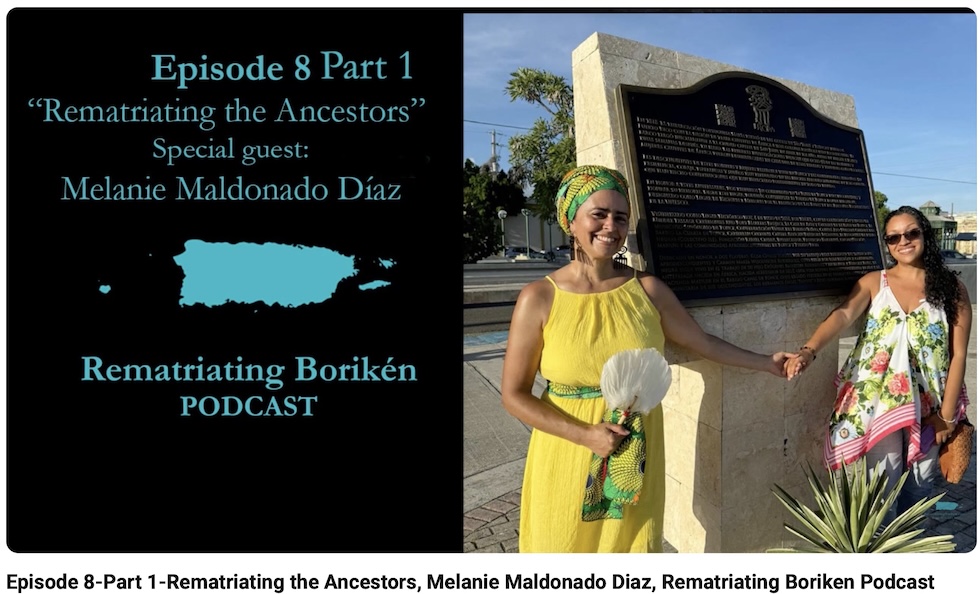
These practices and the resulting events are not hollowed out by demands of tourism. Neither does the approach to the academic study of Bomba replicate the colonizer’s strategy of taking a territory and extracting knowledge. You can listen to Melanie Maldonado Diaz, PROPA’s President, on a two-part episode of Rematriating Boriken that came out last year on YouTube.
Rematriating Boriken Podcast
This is community first. Holding events, such as the series around the Middle Passage Markers Project in Ponce (2024) and another coming in San Juan, that help keep the connections to the past alive . All of this is how this organization works, with its President, Melanie Maldonado Diaz, whose knack for linking people, places and ancestors on Boriken extends our understanding of the past.
I’d love to have your help!
A page for donations is on Facebook. Any amount is welcome.
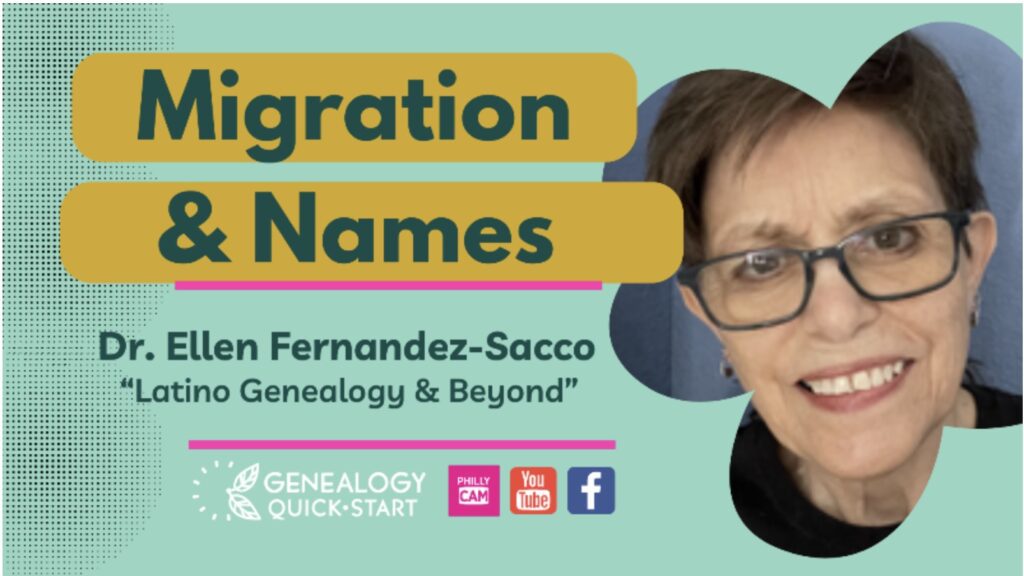
Migration & Names, Genealogy Quick Start, November 2025
This was a busy month! On Tuesday evening, I was a special guest on Shamele Jordon’s Genealogy Quick Start on the Migration and Names episode, talking about my third great grandfather in The Many Names of Telesforo Carrillo, based on a previous blog post. She is an amazing host, and I love her energy. Michael John Neill did the first part of the show, “Benjamin Butler Serves Research Suggestions” making suggestions for locating and verifying a very mobile ancestor who lived in several states over the course of his life.
While I spoke for just a half hour, i’m amazed at how a very long time researching ultimately distilled a story out of documents finally brought together. Thanks to the help of cousins, I pulled together documents to understand more about the struggles that each generation faced. Self identification and self determination weave through the lives of my ancestors. As a child in the South Bronx, I did get to meet Telesforo’s daughter Catalina, my great grandmother, who lived to be 104 years old. I ended with my grandfather’s 1925 passport, a folded page with the only photo of his first wife, Carolina Dorrios Picon and their three children, Bobby, Gloria and Sylvia Fernandez, in a photograph that is now a century old.
There are 213 episodes of Genealogy Quick Start, full of resources and recommendations for your browsing pleasure!
Rediscovering Latinidad, Season 7 Ep.8
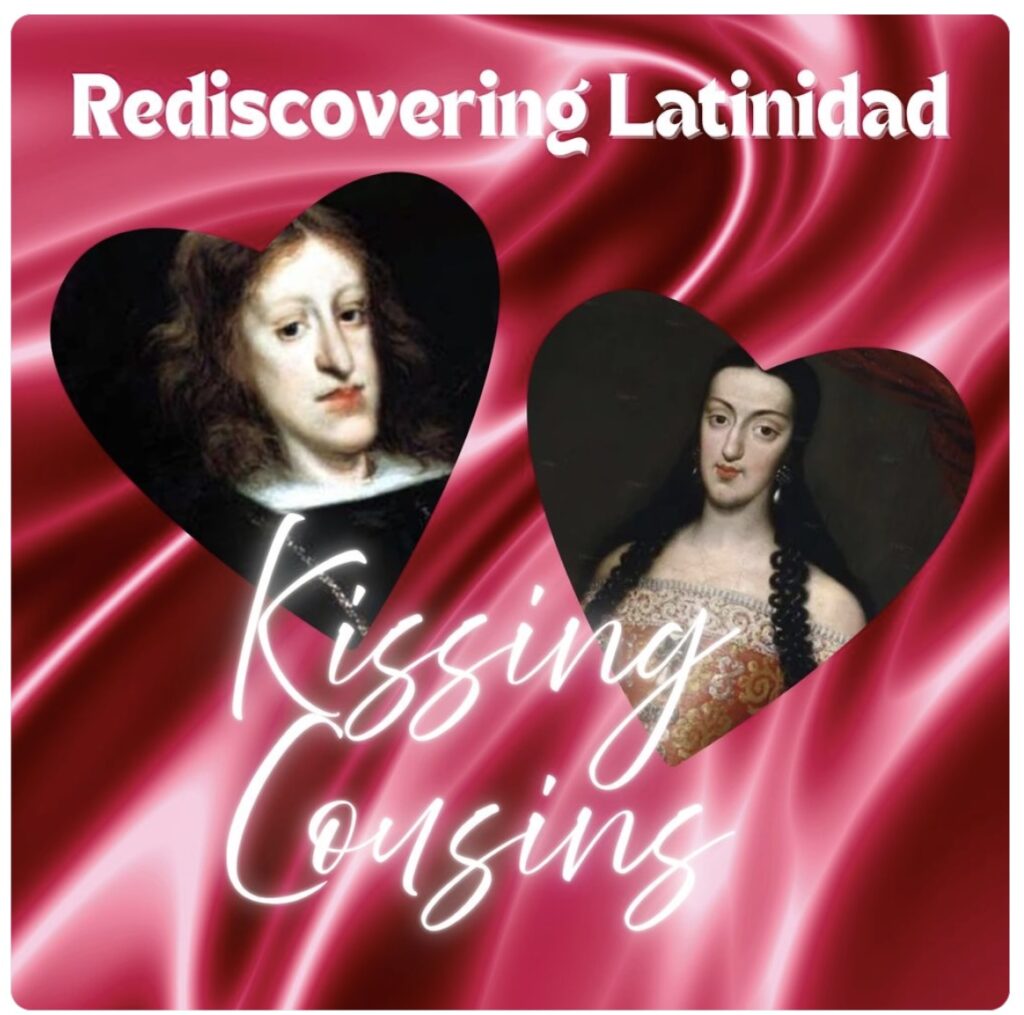
Rediscovering Latinidad released their Kissing Cousin episode– Season 7 Ep. 8 – Cuando los primos se exprimen: La endogamia y el matrimonio entre primos, and I enjoyed talking with hosts Eduardo Rueda and Jellisa. Check it out as we go full cringe with endogamy and cousin marriage! This premier podcast about Latino genealogy, culture, heritage and rich layers of intersectionality also has a Patreon. With seven seasons of podcasts, Rediscovering Latinidad is a great resource for learning more about family history, with links for additional information on each episode page.
Rediscovering Latinidad Season 7 Episode 10
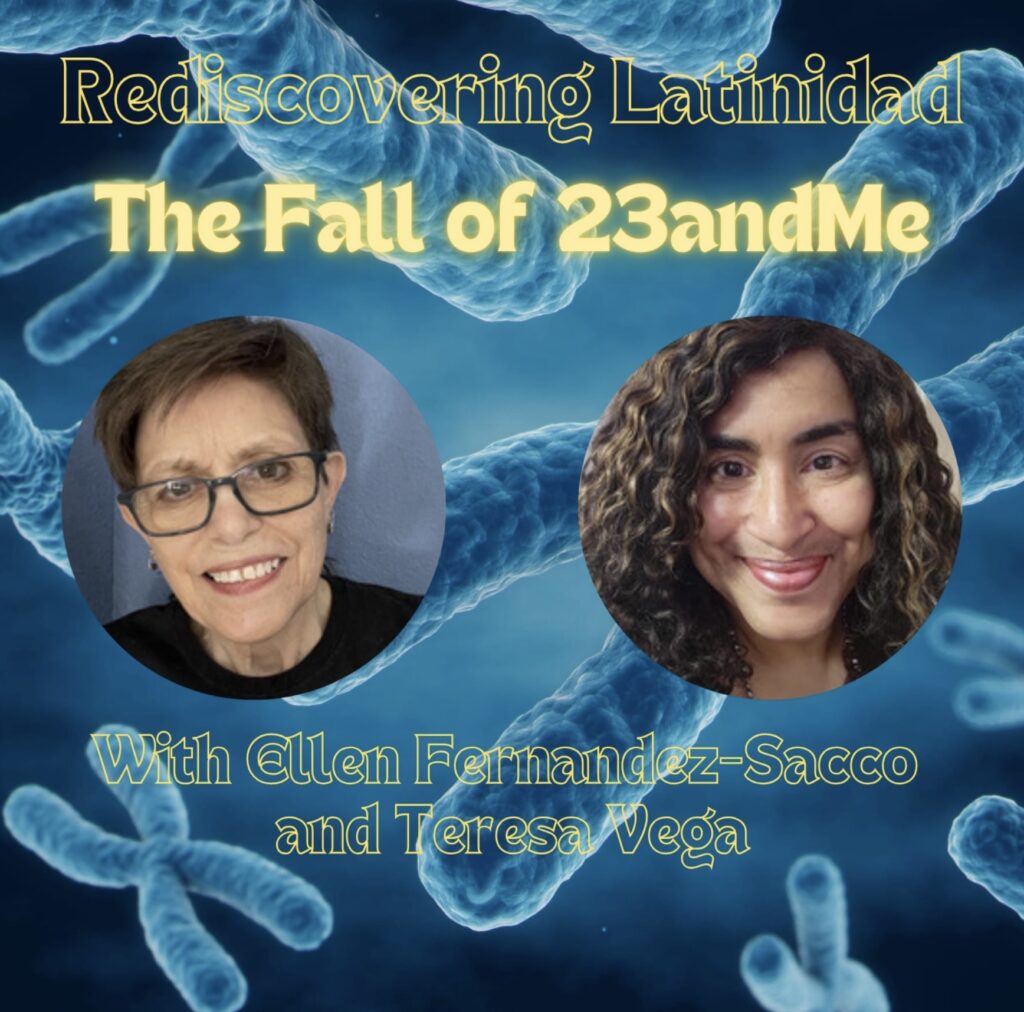
Rediscovering Latinidad also rereleased their most popular episode from Season 7 Episode 10, La Caida de 23andMe/ The Fall of 23andMe, with guests my cousin Teresa Vega and I. Teresa’s extensive knowledge of DNA and complex family histories adds to the discussion. Check out her blog, Radiant Roots Boricua Branches for fascinating research on Revolutionary War ancestors, ancestors from Madagascar, and deep dives into family history.
Moses Williams, cutter of profiles
On November 19, I participated in the Library Company of Philadelphia’s virtual symposium Finding Moses Williams, along with four amazing scholars, who shared new insights on his art, life and family. He left a considerable body of work, and perhaps, descendants. So much to learn from these talks!
Here’s a list of the presentations:
Carol Soltis, Finding Moses in the Peale-Sellers family album.
Nancy Proctor, Presenting Moses at The Peale Baltimore.
Ellen Fernandez-Sacco, Not Yet Completely Free, The Context of Gradual Emancipation & the Family of Moses Williams 1776-1830.
Dean Krimmel, Locating Moses Williams in Philadelphia, new information about Moses Williams’s life and death based on a re-examination of Philadelphia’s primary sources.
Here’s the initial 865 list followed by the municipalities that are in the Cajas recently uploaded to FamilySearch!
Listed below are: Isabela, Camuy, Vega Baja, San Juan, Utuado, Guayama, Juncos, Lares, Hormigueros, Manati, Rio Grande, Comerio, Carolina & last, that big cluster of School Personnel files. What can you find about your ancestors & their communities?
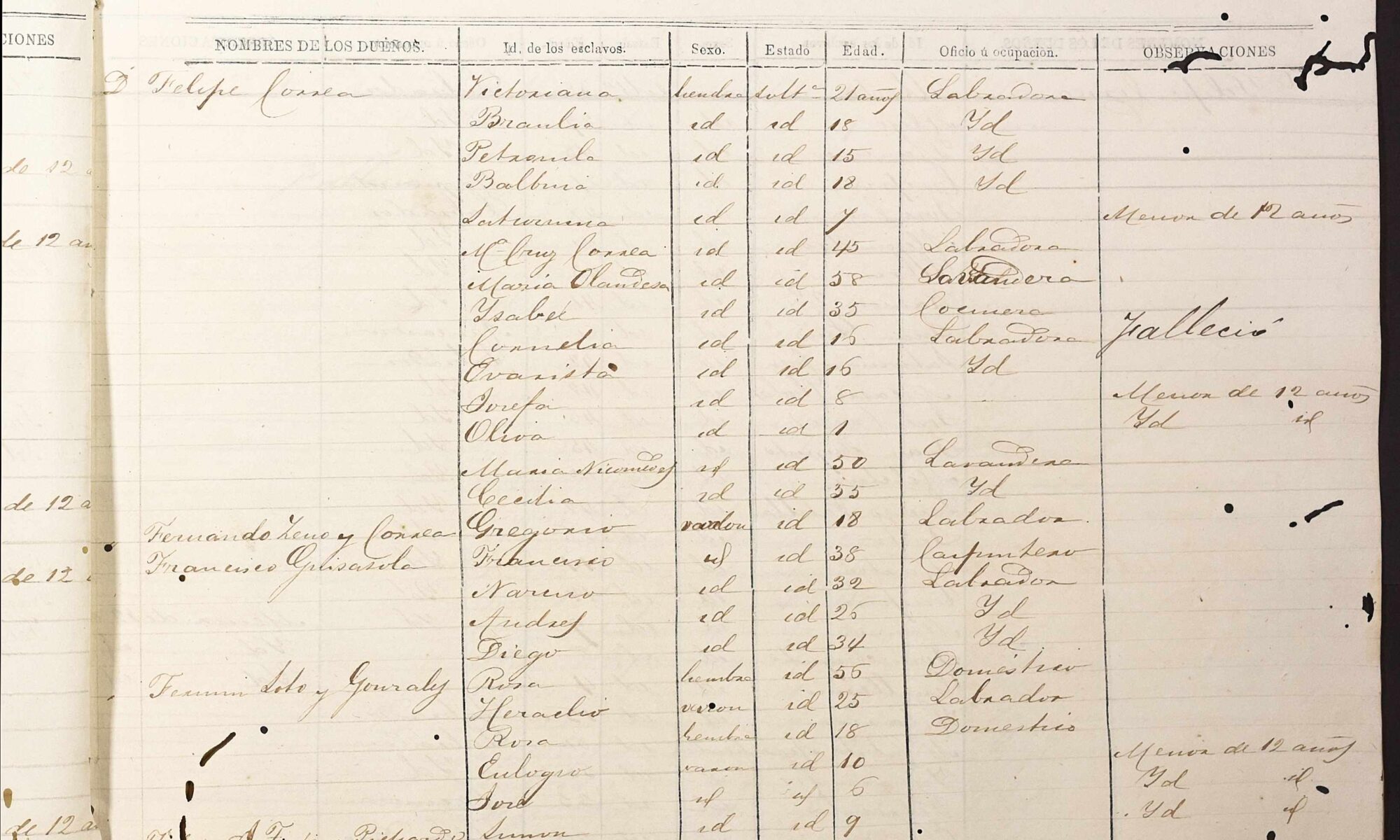
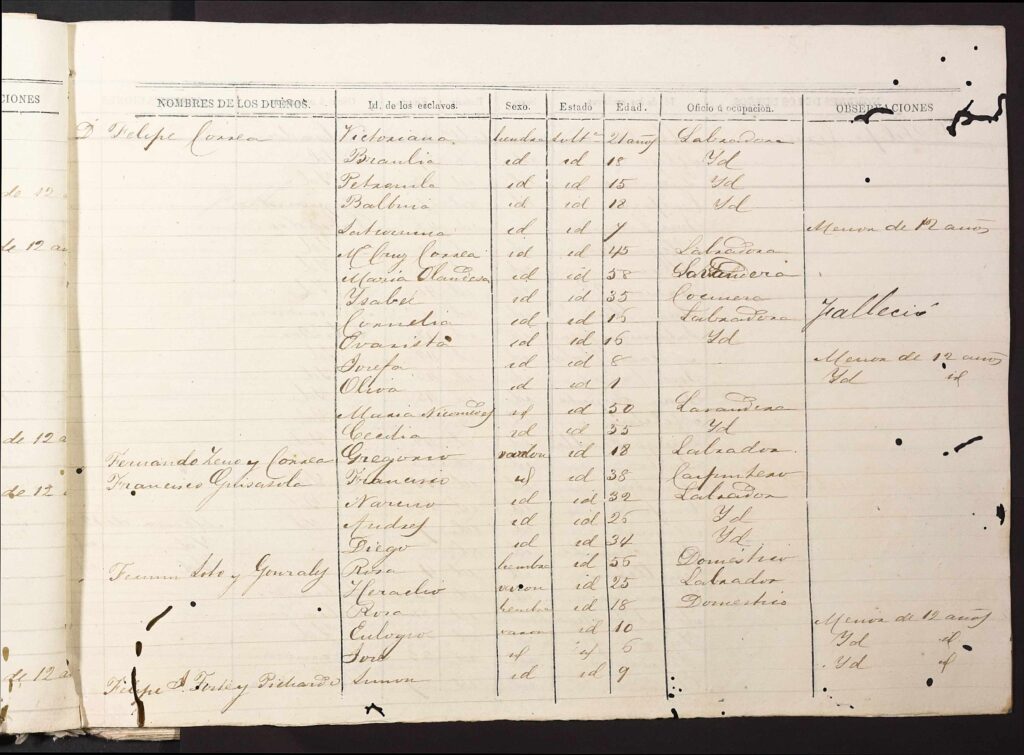
Caja 74, Padron de Esclavos, Arecibo, im 17. FamilySearch
Did you know that 865 sets of documents under Gobierno de Puerto Rico were recently uploaded to FamilySearch last December?
These aren’t indexed yet, but the Caja information and municipality are mentioned. While it’s not every municipality, it’s definitely worth a look!
Some of those included are Isabela, Camuy, Vega Baja, San Juan, Utuado, Guyama, Juncos, Lares, Hormigueros, Manati, Rio Grande, Comerio, Carolina & a big cluster of School Personnel files.
Here are some links to the results to help you get started:
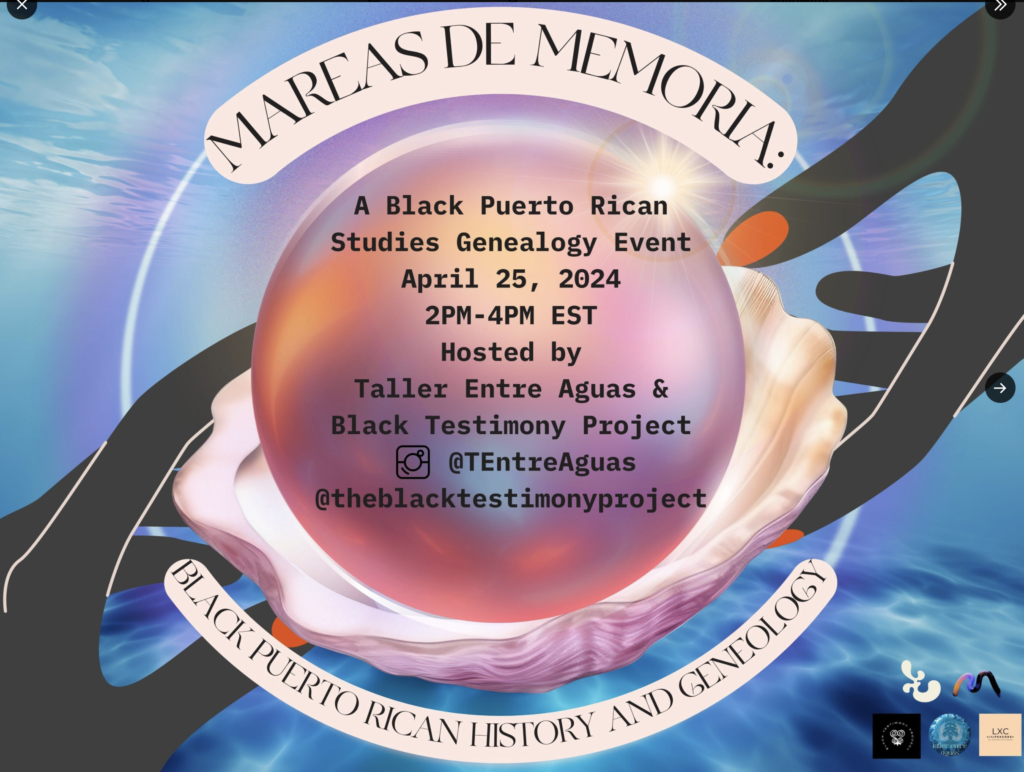
Come to a series of short presentations and a panel discussion on Black History & Genealogy in Puerto Rico! I’m excited to share in the discussion at this event this afternoon, hosted by Taller Entre Aguas & Black Testimony Project.
Join TEA x BTP on April 25, 2024 from 2pm-4pm EST for a special virtual event titled, Mareas de Memoria: Black Puerto Rican History and Genealogy on Zoom.
This has turned out to be a busy month! I finished my last article for the series on “Reconstructing Missing Volume of the Registro Central de Esclavos, pt 4” for the forthcoming volume 24 of Hereditas: Revista de la Sociedad Puertorriquena de Genealogia. I hope to submit “Looking for Lorenzo Ubiles, Alcalde de barrio Humacao 1873.” for the AAHGS Journal shortly.
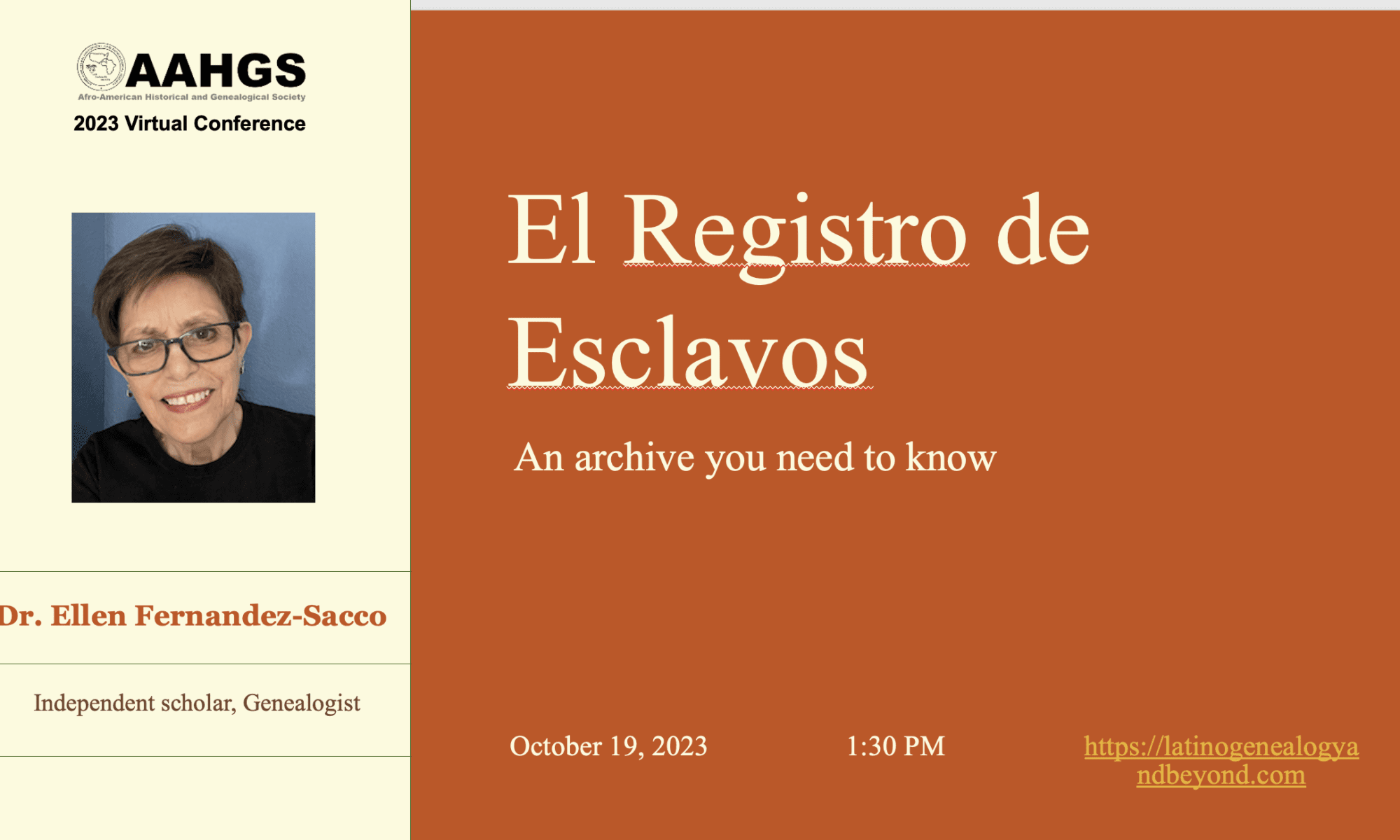
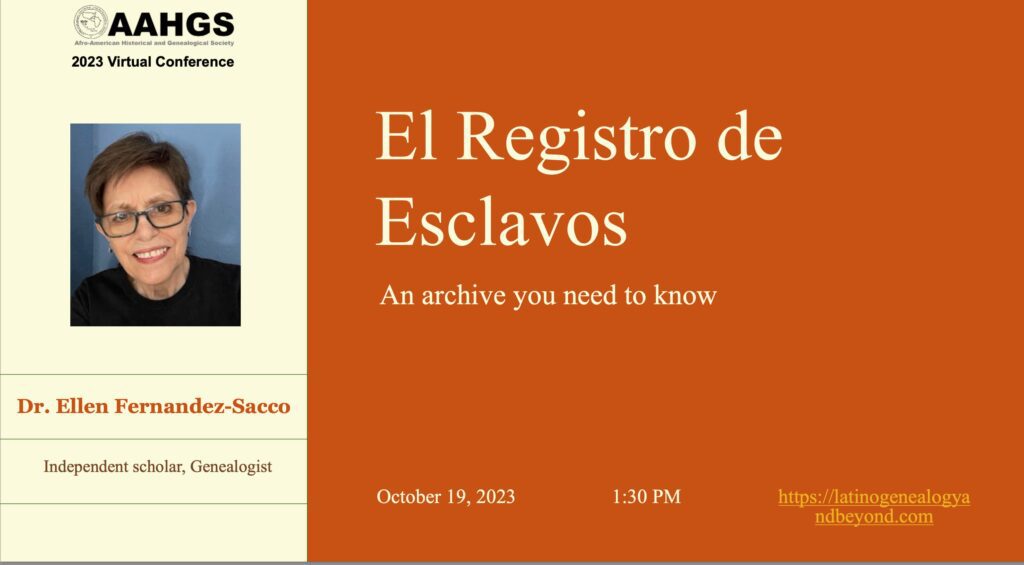
I’m happy to announce that on Thursday October 19, 1:30 PM-2:30 EST, I’ll be presenting “El Registro de Esclavos: An archive you need to know”, at “Hidden in Plain Sight: Recovering the erased stories of our ancestors in the United States and the Caribbean”, the 44th Annual 2023 AAHGS Virtual Conference. Excited to be among so many great presentations & presenters that includes friends & family from Black ProGen Live! Sessions will be available until Dec 31.
Here’s the description: The process of emancipation in Puerto Rico formally began in 1868, with the registration of over 30,000 enslaved persons using cedulas, small registration forms 6 x 8” in size. The information on these forms were copied to create the volumes of the Registro de Esclavos, issued in 1872. FamilySearch microfilmed two series of these documents from the enormous collection of Gobiernos Españoles collection. These are now searchable on the FamilySearch site as “Puerto Rico Slave Registers, 1863-1879”. These entries shed light on the identities of people as they transitioned to freedom just fifteen years before the establishment of the Registro Civil (Civil Registration) in 1885 and the formal end of slavery in 1886. The information covers name, origin, parents, partner, children, enslaver, physical details and issues around the purchase of freedom, manumission, or even the death of the person listed. The ages range from days old to persons in their 80s. These documents are useful for identifying family members and confirming their identities and locations pre-1885, and who may not appear in the 1910 census. Recently digitized archives on the Archivo Digital Nacional de Puerto Rico (ADNPR.net) that overlap with the information in the Registro de Esclavos will be covered. This work is a contribution to the ancestors, to help bridge them with their descendants.
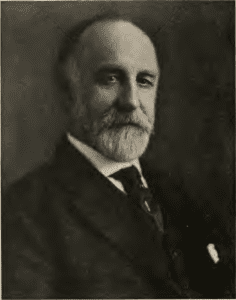
Jessie Walter Fewkes (1850-1930) was an American anthropologist, archaeologist and writer who worked in the Southwest US and the Caribbean.
Jesse Walter Fewkes, Wikipedia.com
I keep looking at Fewkes’ diary, parts of which read like a shopping list for Indigenous objects. Little has been written on his time in Puerto Rico, which was a result of the ‘demand for more scientific literature on Porto Rico and the West Indies’, which led to field work in the islands and publication of the Report on the Aborigines of Porto Rico and Neighboring Islands.’ [1]
Here’s an excerpt from Fewkes’ handwritten diary, from April 1904:
“A man ploughing a few days ago found a fine collar in his field
I was too late to get it as it had been given to Mr. Fritsche who will present it to a Berlin Museum-
Mr Trujillo of Ponce has a fine tripointed idol and a spherical bowl which he found at Guayanilla. Evidently then are many other things in the barrio called Indios when there was formerly an Indian settlement.
Nazario found many specimens in this region –“
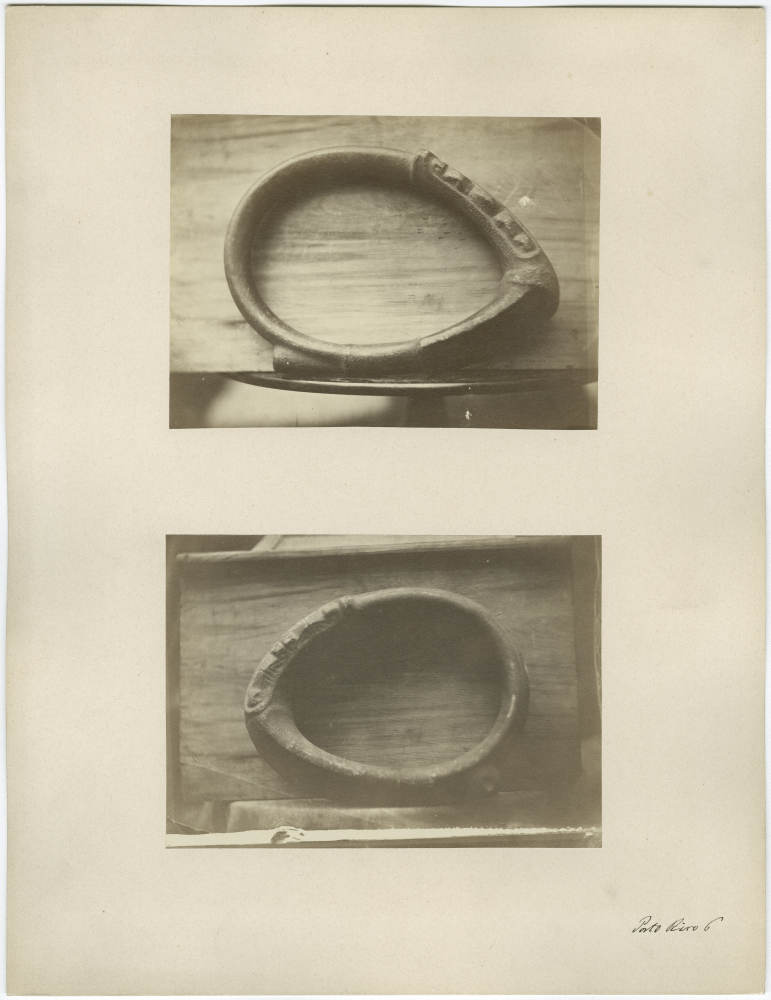
Fotonachweis: Staatliche Museen zu Berlin, Ethnologisches Museum /CC BY-NC-SA 4.0
I couldn’t find more on Mr. Trujillo or Mr. Fritsche, but I did find the ‘Porto Rico 6’ photograph of a coa (also called a stone collar) whose accession date at the Berlin Ethnologisches Museum means it very likely entered the collection close to when it photographed by Adolf Bastian, before 1905. Given the timing, it’s likely the same artifact.
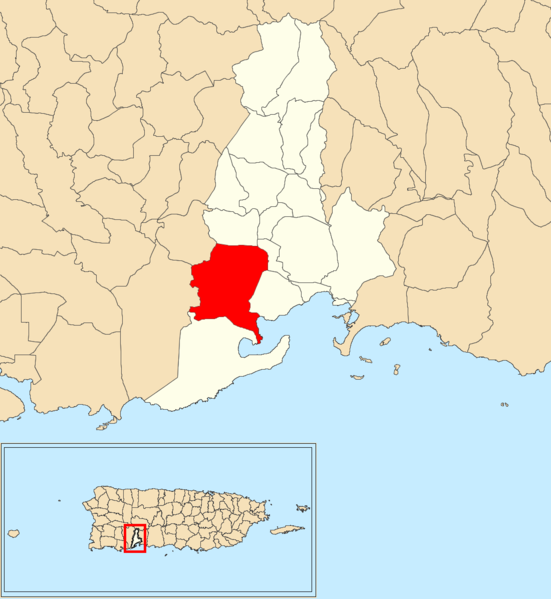
Barrio Indios, Guayanilla
Location of Barrio Indios, Guayanilla. Wikipedia.com
So, what about this settlement? As historian Rafael A. Torrech writes, Barrio Indios, Guayanilla, on the south of the island, is where the yukayeke of cacike Agueybana existed , where early wars of colonization took place. Eventually, sugar plantations covered the landscape and artifacts from ancestors emerged from the ground as it was prepared for planting. Collections were created by hacendados, and once the US had Puerto Rico as a colony, an international rush for artifacts intensified. Fewkes’ notebooks of his travels reveal a range of persons that he encountered while crossing the island from San Juan to Utuado, and then south to Ponce and the Indiera. Some people gift him objects like stone hatchets, buys others and inventories sites and the objects harvested from them.
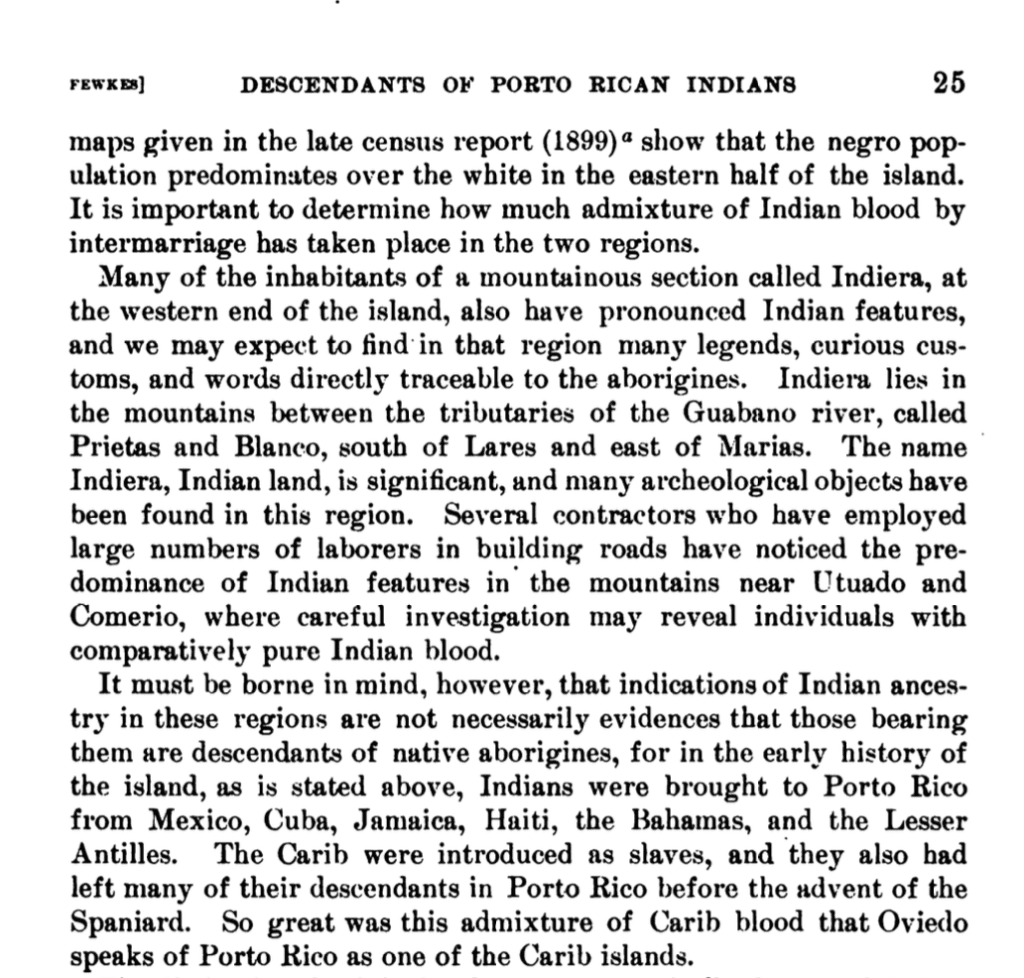
As stone objects turned up across the island, anthropologists and archaeologists began to surmise their age and purpose. Taino people were framed as outside of time although they are acknowledged and described as present in Fewkes’ essay. Looking back, he is evidently troubled by the complexity of AfroIndigenous identity. The idea of the ‘pure Indian’ colors his commentary, and oral history is suspect; notice that Natives are the laborers hired to build the roads in Utuado and Comerio; the area is even called Indiera. Fewkes goes on and acknowledges the presence of Indian ancestry, then the diversity of the Indigenous slave trade defeats the idea of any contemporary Taino identity on Boriken. No surprise really, as this is the heyday of Eugenic thought, which communicated and structured the spectacles of the World’s Fair and Expositions.
Jesse Walter Fewkes, “The aborigines of Porto Rico and neighboring islands.” (1907)
Envisioning Porto Rico, 1899-1904
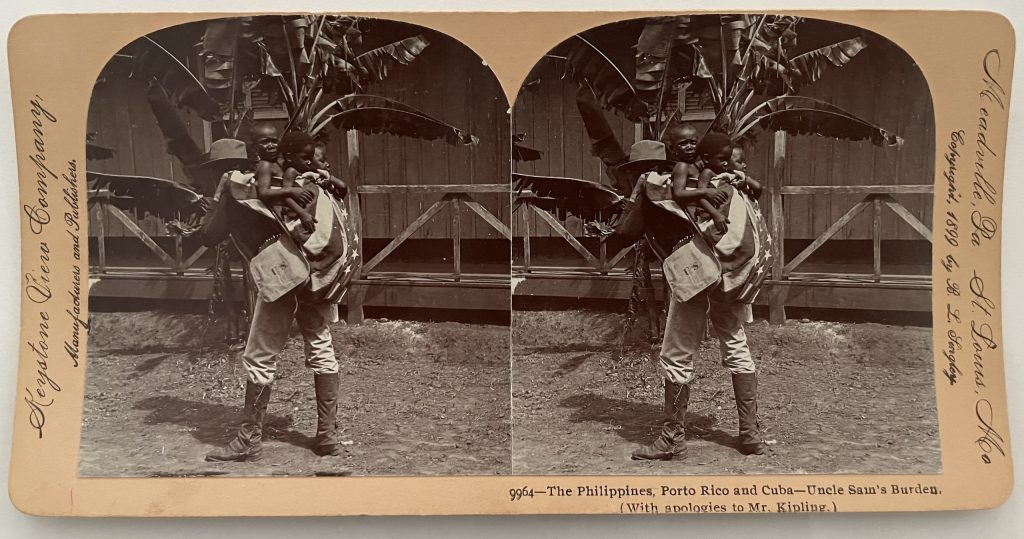
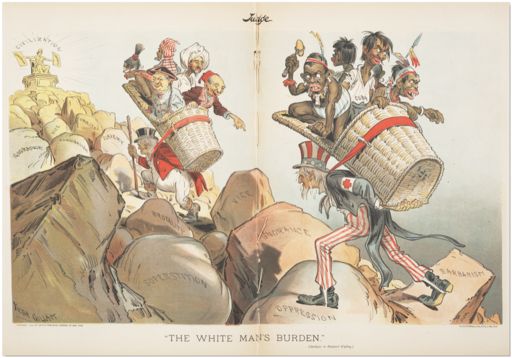
Here is an example of imperialist propaganda that circulated in the wake of the Spanish-American War that promoted the view of Indigenous people as incapable of self-governance and rule. Spain’s three colonies became US property. The Philippines, Puerto Rico and Cuba are here shown as 3 Black infants wrapped in a US flag on the back of a soldier who stands in for ‘Uncle Sam’. It’s a foto reenactment of the 1899 Victor Gilliam cartoon, “The White Man’s Burden” from Judge magazine. This anti-Native anti-Black perspective is part of the context for understanding the relationship of Native peoples to the US at the turn of the century, and at the 1904 St. Louis Exposition. Often the more offensive displays that underwrote white supremacy were in the entertainment areas of the fair, readily absorbed by millions under the rubric of ‘fun’.
9964.-Phillipines, Porto Rico and Cuba–Uncle Sam’s Burden. (With apologies to Mr. Kipling.) 1899. Keystone View Company stereo card. Collection of the author. Victor Gilliam, “The White Man’s Burden.”, Judge magazine, 1899. Victor Gillam, Public domain, via Wikimedia Commons
Fewkes’ Reference to Father Nazario
In the 1870s, Father Jose Maria Nazario Cancel was brought by dona Juana Morales, a descendant of Agueybana to a cluster of some 800 stone pieces that she had protected over time. Today the archaeologist Reniel Rodriguez (UPR- Utuado) is researching the stones, and considers them as objects that date from precolumbian contact- 900BC-900AD. Yet the stones are not Taino and were not among those purchased by Fewkes in 1902-1903.
Not far from Guayanilla is the Centro Ceremonial Caguana, “the largest ceremonial site of its kind, not only in Puerto Rico, but the entire West Indies” built between 1200-1500 AD in the La Cordillera Central, the central mountain range. In terms of DNA testing, people from here, on the western side of the island tend towards higher percentages of Indigenous ancestry.
In terms of Caguana, it’s a ‘lived landscape’ a place where space, identity and heritage intersect and embodies group memory. It’s not static, but changes over time, and is “a locus for negotiating the dissonance between colonial and indigenous identities.” Despite years of neglect by the ICP (Instituto de Cultura Puertorriquena), it was a place vital for descendants to rediscover their cultural identity. Over five decades, Caguana has become a sacred site for Taino people, and in 2003-2005, the culture war between Taino activists and the ICP came to a head. (Diaz 232-233) Some still think Arawakan peoples, among them the Taino are extinct, and part of this thinking is the result of paper genocide.
The landscape in Puerto Rico is subject to constant disturbances from agriculture and development. The discovery of artifacts often means site destruction in order to avoid building delays as some have documented on video. There’s still much to learn from these archaeological sites, however for different audiences, namely Taino communities, the stakes are different. It’s about colonization and collections, and a difficult path to official recognition. It’s about seeing that connection between the past and present, learning what we can from these moments in colonization.
From ‘Elbow stone’ to Coa
As for the ‘elbow stone’ or ‘stone collar’ that Fewkes missed out on purchasing, this is called a coa, recognized as a sacred form by Taino peoples. It is based on the blending of two forms, the footrest of a hardwood digging stick for agriculture with that of the great serpent, whose head was carved into the foot rest. By bending the stick, using fire and water, the resulting form references the coiling of a snake and the form of human uterus, symbol of time and its passage as a spiral.
At some point, this wooden form was adapted into a stone carving with elements that reference the Taino worldview. You can read more about this on the Caney Circle webpage here.
1904: St. Louis Exposition
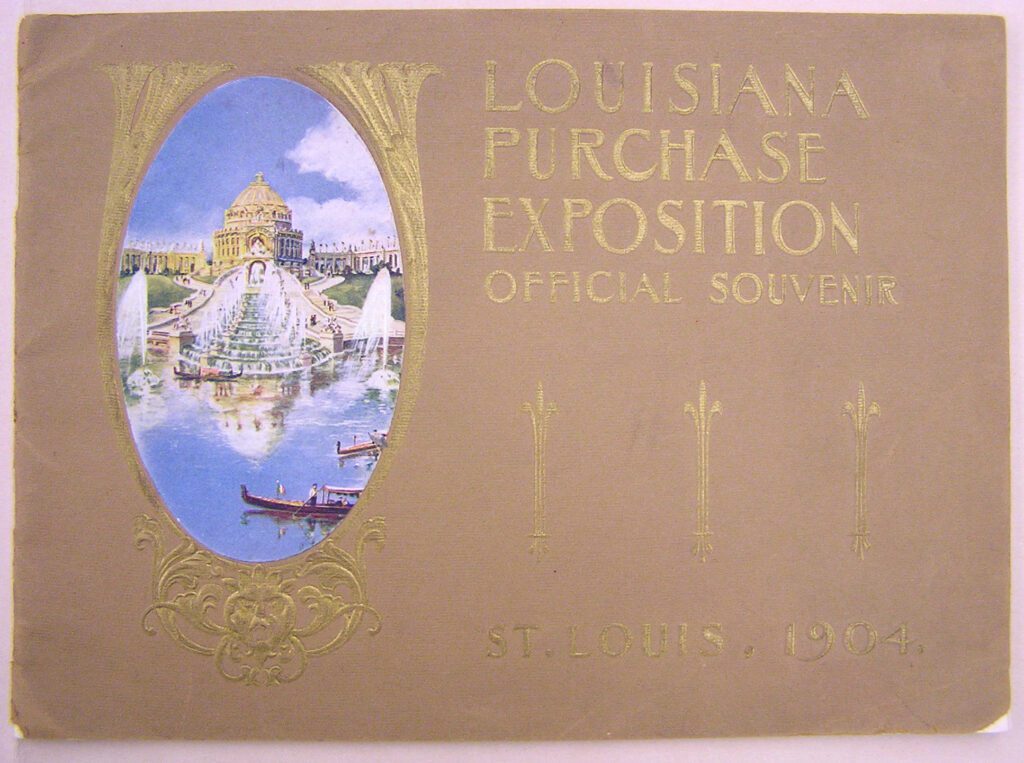
Louisiana Purchase Exposition Official Souvenir pamphlet. Smithsonian Institution
So what was some of the motivation for creating the collection? Fewkes brought together an assemblage of some 550 pieces of Indigenous / Arawakan stone artifacts exhibited at the 1904 St Louis Exposition. Our ancestors stone artifacts had a role at the fair, as a material assurance that primitive people were in the colonies. Here, representing ‘Porto Rico’ it suggests that Native people were extinct a part of something rapidly fading, a group no longer with us. How convenient.
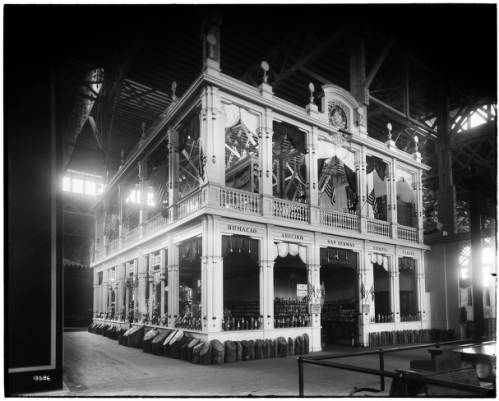
The roofless building of Puerto Rico’s two floor ‘pagoda’ within the Agricultural Building is surrounded by props, sawed off barrel tops and angled logs in front to suggest trade, and tradition through the structure’s French detailing. The first floor “was dedicated to agriculture, mines, forestry and a few of the manufactures exhibits.” The second floor held “liberal arts and manufactures exhibits”, and a needlework display by the Women’s Aid Society, San Juan and the Benevolent Society, Ponce. The focus was on exports of coffee, sugar, tobacco, cotton, liquor and pharmaceutical products. The Puerto Rican legislature appropriated $30,000 for “the purpose of representation at the Louisiana Purchase Exposition.” Yet it had no separate catalog, and no association with Fewkes’ collection.
I’ve searched collections for additional information on the stone artifacts at the Exposition, but the only mention of them is in Fewkes’ article in the Smithsonian papers. This collection wasn’t displayed here.
Puerto Rico Pavilion, designed by Armando Morales, Agriculture Building, 1904 St Louis Exposition. St Louis Public Library Digital Collections.
Consuming the Primitive
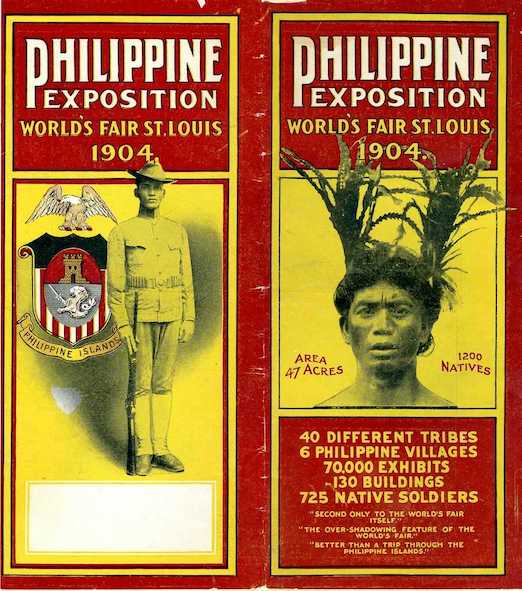
Advertisment, Philippine Exposition at World’s Fair St. Louis 1904. Wikimedia Commons.
What grabbed attention at the 1904 fair was the display of Indigenous people brought from Africa and the Philippines. These were literally human zoos that several million people visited at St. Louis. They were subjected to perform as living examples of primitive people, yet the barbaric genocidal behaviors of the US go unmentioned. So, it seems stone objects of a supposedly extinct people were reassuring for the colonizer’s frame of reference.
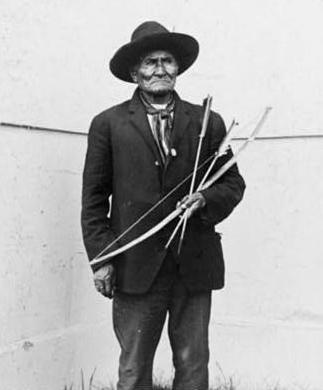
Over 1200 persons were exported to the Exposition for display, including the Bedonkohe Apache leader and medicine man Goyathlay, known as Geronimo. While a prisoner of the US Government, he was exhibited at the 1898 Trans-Mississippi Exposition in Omaha Nebraska, the 1901 Pan-American Exposition in Buffalo, and at the 1905 inauguration of Theodore Roosevelt. He died imprisoned at Fort Sill in 1909. [3]
Goyathalay, known as Geronimo. (1829-1909) Wikimedia Commons.
Collection, collection….
Where were the stones shown? I still haven’t found a precise location at the 1904 Exposition.
And after 1904, the collection of Arawakan stone objects left St. Louis and were returned to the bowels of the Smithsonian, where they were eventually put into their storage facilities. Back in 2004, I met Ricardo Alegria, QEPD, the Director of the ICP who told me he anticipated the day the objects at the Smithsonian would be repatriated to the island. At that time, I didn’t realize how different an idea of Nation would be for me today. One day, Taino people will have facilities ready for their welcome return.
Rafael A. Inocencio Torrech: “Según diversos historiadores, varios yucayeques taínos de importancia estaban ubicados en el área sur de Puerto Rico, incluyendo el del legendario Agueybaná. Reconocidos historiadores como Gonzalo Fernández de Oviedo –contemporáneo a la temprana colonización– ubican la aldea de Agueybaná en la ribera del Río Coayuco (hoy Río Yauco), con una población estimada entre 1,000 y 5,000 habitantes. Fue en la boca del Río Coayuco, según el historiador Cayetano Coll y Toste, que las fuerzas de Ponce de León derrotaron por primera vez a los indígenas en la llamada rebelión de 1511. La ribera y la desembocadura de este río, hoy conocido como Río Yauco, es consistente con la localización actual del Barrio Indios. El Barrio Indios también nos legó la Biblioteca de Agueybaná: uno de los hallazgos arqueológicos más singulares y excepcionales del País…” Rafael A. Torrech Inocencio, Barrio Indios, Guayanilla. 80grados.net 21 Feb 2020. https://www.80grados.net/barrio-indios-guayanilla/
Renal Rodriguez Ramos, Los Piedras de Padre Nazario, CEAPRTV, Centro de Estudios Avanzados, 19 May 2016.
Jesse Walter Fewkes, “The aborigines of Porto Rico and neighboring islands.” Twenty-Fifth Annual Report of the Smithsonian Institution to the Secretary of the Smithsonian, 1903-1904. Washington DC: SI. (1907) 1-220. https://archive.org/details/annualreportofbo1906smitfo
“Porto Rico” The Final Report on the Louisiana Purchase Exposition. 331-332.
Rosalina Diaz, “El Grito de Caguana: Identity Conflict in Puerto Rico.” in Diane F. George & Bernice Kurchin, Archaeology of Identity and Dissonance: contexts for a brave new world. U Press of Florida, 2019, 229-250.
Appendix: Writings of Jesse Walter Fewkes on the Caribbean
On Zemes from Santo Domingo. Am. Anthrop., vol. iv, no. 2, pp. 167-175, Washington, 1891.
Prehistoric Porto Rico. Address by the Vice President and Chairman of Section H, for 1901, at the Pittsburgh meeting of the Amer. Asso. Adv. Sci. Proc. Amer. Asso. Adv. Sci., vol. li, pp. 487-512, Pittsburg, 1902. Reprinted in Science, n. s. vol. xvi, no. 394, pp. 94-109, New York, 1902. Translated in Globus, Band Ixxxii, Nrs. 18 and 19, Braunschweig, 1902.
Prehistoric Porto Rican pictographs. Am. Anthrop., n. s. vol. v, no. 3, pp. 441-467, Lancaster, 1903.
Precolumbian West Indian amulets. Am. Anthrop., n. s. vol. v, no. 4, pp. 679-691, Lancaster, 1903.
Preliminary report on an archaeological trip to the West Indies. Smithson. Misc. Colls., Quarterly Issue, vol. 45, pp. 112-133, Washington, 1903. Reprinted in Sci. Amer. Suppl., vol. Ivii, pp. 23796-99, 23812-14, New York, June 18-25, 1904.
Porto Rico stone collars and tripointed idols. Smithson. Misc. Colls.
Porto Rican elbow-stones in the Heye Museum, with discussion of similar objects elsewhere. Am. Anthrop., n. s. vol. xv, no. 3. pp. 435-459, Lancaster, 1913. Reprinted as Cont. Heye Mus., vol. i. no. 4.
[Report on] Ethnological investigations in the West Indies. Explorations and Field-work of the Smithson. Inst, in 1912, Smithson. Misc. Colls., vol. 60, no. 30, pp. 32-33, Washington, 1913. lls., Quarterly Issue, vol. 47, pt. 2, pp. 163-186, Washington. 1904.
Prehistoric culture of Cuba. Am. Anthrop., n. s. vol. vi, no. 5, pp. 585-598, Lancaster, 1904.
The aborigines of Porto Rico and neighboring islands. Twenty-fifth Ann. Rept. Bur. Amer. Ethn., pp. 3-220, Washington, 1907.
Further notes on the archaeology of Porto Rico. Am. Anthrop., n. s. vol. x, no. 4, pp. 624-633, Lancaster, 1908.
An Antillean statuette, with notes on West Indian religious beliefs. Am. Anthrop., n. s. vol. xi, no. 3, pp. 348-358, Lancaster, 1909.
Relations of aboriginal culture and environment in the Lesser Antilles. Bull. Am. Geog. Soc, vol. xlvi, no. 9, pp. 662-678, New York, 1914. Reprinted as Cont. Heye. Mus., vol. i. No. 8.
A prehistoric stone collar from Porto Rico. Am. Anthrop., n. s. vol. xvi, no. 2, pp. 319-330, Lancaster, 1914.
[Report on] Antiquities of the West Indies. Explorations and Field-work of the Smithson. Inst, in 1913, Smithson. Misc. Colls., vol. 63, no. 8, pp. 58-61, Washington, 1914
Vanished races of the Caribbean. Abstract of paper read before the Anthrop. Soc. Washington, Nov. 3, 1914. Journ. Washington Acad. Sci., vol. v, no. 4, pp. 142-144, Baltimore, 1915.
Prehistoric cultural centers in the West Indies. Journ. Washington Acad. Sci., vol. v, no. 12, pp. 436-443, Baltimore, 1915.
Engraved celts from the Antilles. Cont. Heye Mus., vol. ii, no. 3, New York, 1915.
Archaeology of Barbados. Proc. Nat. Acad. Sci., vol. i, pp. 47-51, Baltimore, 1915.
Prehistoric island culture areas of America. Thirty-fourth Ann. Rept. Bur. Amer. Ethn., Washington, . [In press.]
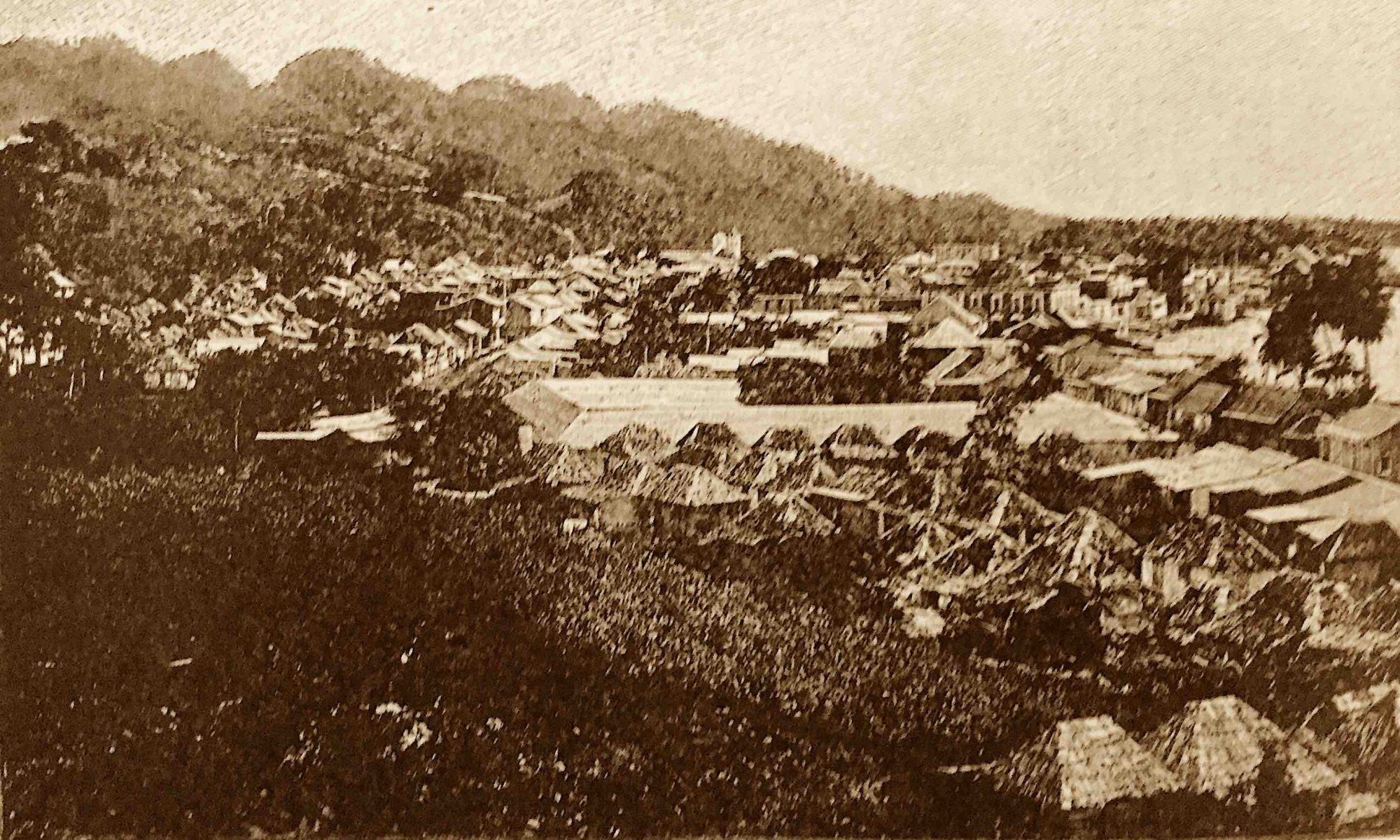
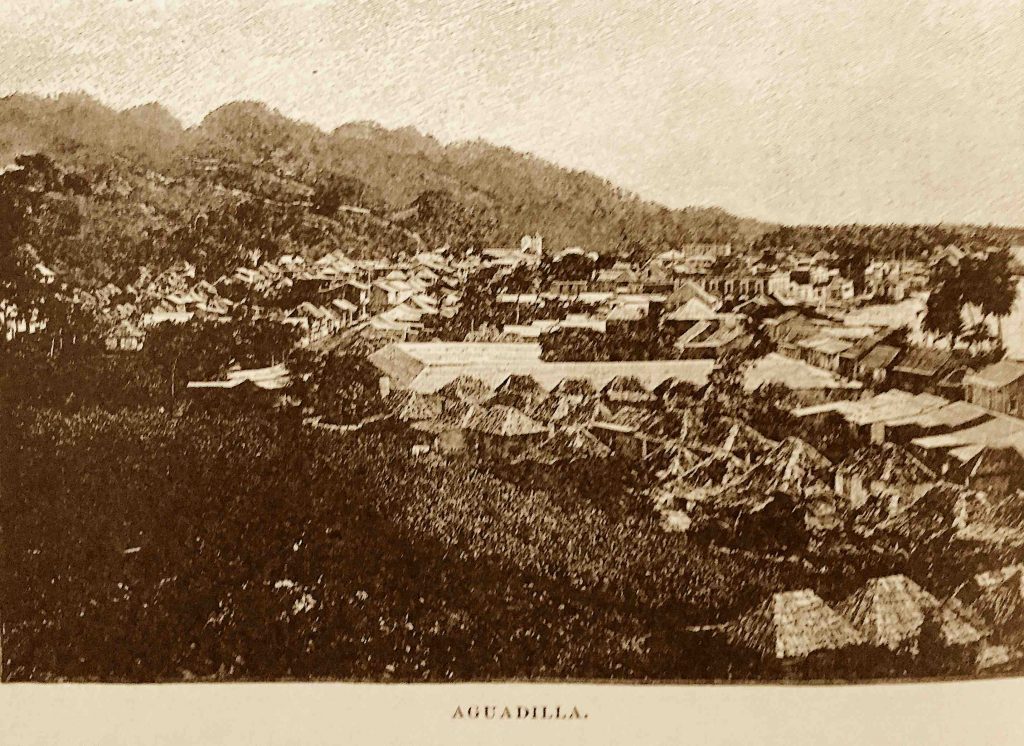
View of Aguadilla, 1898, from Murat Halstead, Full Official HIstory of the War with Spain: The True Inwardness of the War. [HL Barber, 1898]
Slavery was a Family Business
Right now i’m looking over this entry for a property sale Aguadilla from February 18541. It’s a lock, stock and barrel sale between first cousins, and the order of importance for the details enumerated is very telling.
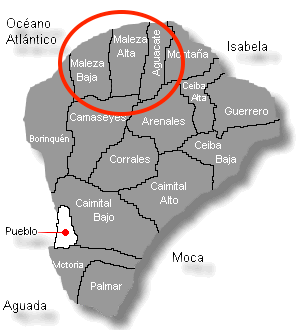
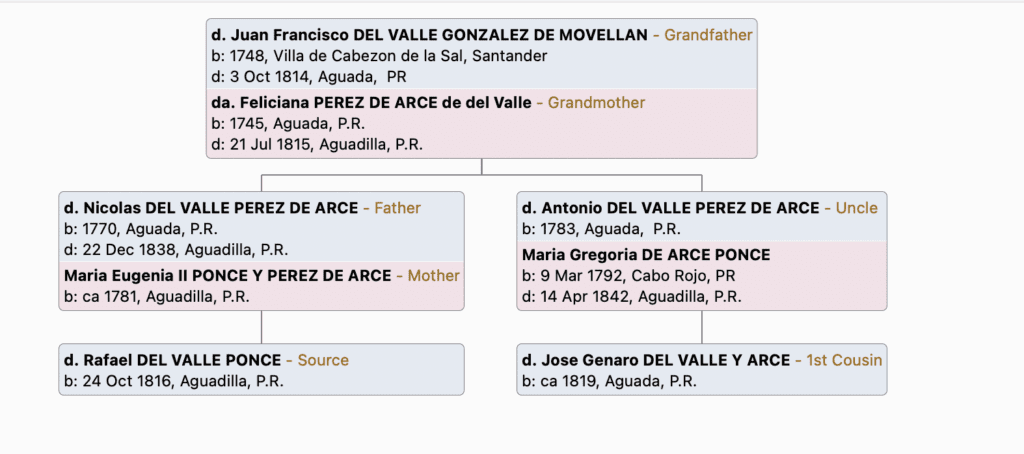
It begins with the layout of land in Barrio Malezas, Aguadilla, a 180 cuerda (174.6 acres) property, alongside several other plantation owners. D. Rafael del Valle y Ponce is selling this estate to his first cousin, D Jose Genaro del Valle y Arce. I have distant ties to these families, with Rafael del Valle being my 1C5R and Jose Genaro del Valle my 2C4R. They were close and the relationship chart below outlines the cousin relationship between both men. Note that Rafael was also related to Jose Genaro’s mother, however, this set of relationships (via the Ponce line) is not included here.
Relationship chart for the del Valle cousins, E. Fernandez-Sacco, Reunion 13, 2022.
Rafael’s father, Nicolas del Valle y Perez de Arce served as Alcalde (Mayor) of Aguadilla three different times, in 1814, 1820-21 and in 1836. Rafael was one of his eight children with Eugenia II Ponce y Perez de Arce (b. abt. 1781).
Rafael’s cousin, Jose Genaro del Valle y Arce (bca 1819) was the son of Antonio del Valle y Perez de Arce (b.1783) and Maria Gregoria de Arce Ponce (1792-1842).
Jose Genaro’s father Antonio, served as Alcalde of Aguadilla just once, in 1837. Clearly, this family possessed a degree of political clout in the municipality. In addition, by having this sale occur within the family, they kept their wealth. As a business practice, endogamy helped to insure trust in partnerships at a time before banks existed on Puerto Rico.
An Arrangement
In January 1853, both Rafael del Valle and Jose Genaro del Valle went before the notary to record an arrangement that gave Jose Genaro del Valle the power to administer the cattle ranch in Barrio Malezas, including the enslaved persons, the animals there, and a house in town. By 11 February 1854, the situation had changed. Rafael’s contract which paid 400 pesos yearly to Jose Genaro, as he points out in the document, was now rescinded3. Next on that same day, the sale of the property from Rafael del Valle to Jose Genaro del Valle was recorded. Jose Genaro del Valle was the new owner.
The Sale
The property transfer is just a few paragraphs long. Laid out are the names of the other property owners: Antonio Almeida & d. Manuel Badillo on the south along the Royal road of the mountain, on the east with Da. Rosa de Santiago and the Royal road that goes by the front to d. Patricio González, and on the west side, with Da.María Ponce and Da.Josefa Mirle. Wives could also own, manage businesses and inherit property independently of their husbands. Each person ran their own hacienda or estancia that included enslaved ancestors.
Maria Ponce is most likely Maria Eugenia II Ponce y Perez, wife of Nicolas del Valle; Josefa Mirle is Josefa Mirle Gonzalez, wife of Francisco Almeida of Portugal. The baptism record for their daughter Manuela Almeida Mirle of 1817 mentions that she was born in Maleza Alta4, which helps localize the family in a specific barrio. Both the Ponce and Mirle families, like the del Valle, held larger numbers of enslaved people to work their ranches, farms and plantations.
The Valle plantation held some 100 head of cattle, 6 horses and two mares with foals. After the animals were enumerated in the deed, nineteen people held in bondage were listed. The price for the estate was 14,000 pesos macuquina with 2,700 pesos of the total owed to Eugenio Alers, a hacendado who was building his holdings between Aguadilla and Isabela and lending money mid-century to property owners in the area.
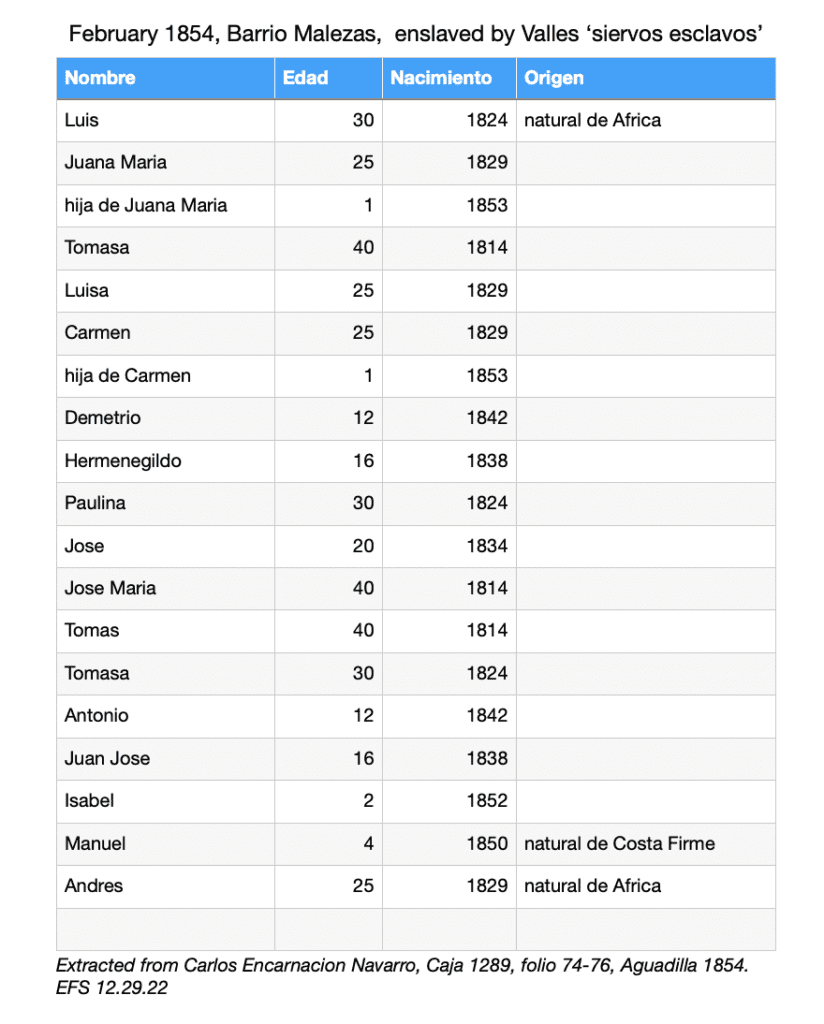
Values for the nineteen enslaved persons, which may include at least two clusters of family, were not specified. Two persons on the list survived the Middle Passage, and another was from Costa Firme, Venezuela, pointing to the global connections of these transactions. The rest were criollos, born in Puerto Rico; there were ten male and nine females of different ages, three of them too young to work. They were termed ‘siervos esclavos‘, enslaved servants, perhaps more concerned with running a household and raising livestock. There is no mention of specific duties in the deed.
Aside from two 40 year old men, these ancestors were young, and perhaps some of them made it into the pages of the Registro Civil. If they did, it seems unlikely they used their former enslaver’s surname after freedom.
Say Their Names
Here are the names, ages and approximate dates of birth for these ancestors in Aguadilla in February 1854.
I plan to look back to records from 1822 and then to the cedulas of 1868-70 of the Registro de Esclavos to see if any of these ancestors remained under the control of del Valle family members. Hopefully there is more to learn about them.
1 Haydee E. Reichard de Cardona, Haciendas agrícolas del triángulo noroeste de Puerto Rico, sus dueños e historias. Jose A Amador Acosta, Ed. Editorial HER Historias y Escritos Riquenos, 2020.
2Carlos Encarnacion Navarro, Fondo de Protocolos Notariales, Caja 1289, Serie Aguadilla, Pueblo Aguadilla, Escribano Lcdo. Manuel Garcia, 1854. AGPR. En Aguadilla 2-11-1854 fol.74 a 76 ante el insfrascripto escribano Real y público y testigos que se expresaran compareció D.Rafael del Valle de este vecindario y dijo que otorga venta Real y absoluta a favor de D.José Genaro del Valle también vecino una estancia en esta juridicción en el barrio de Malezas compuesta de 180 cuerdas colindantes al norte con Antonio Almeida y D.Manuel Badillo, por el sur con el camino Real de la montaña, al este con Da.Rosa de Santiago y el camino Real que pasa por el frente a D.Patricio González, al este con Da.María Ponce y Da.Josefa Mirle incluidas las plantaciones en ellas, 100 cabezas de ganado,6 caballos,2 yeguas con crías y los siervos esclavos Luis natural de áfrica de 30 años,Juana María de 25 años y su hija de un año,Tomasa de 40 años, Luisa de 25 años, Carmen de 25 años con una hija de un año,Demetrio de 12 años, Hermenegildo de 16 años,Paulina de 61 30 años, José de 20 años, José María de 40 años,Tomás de 40 años,Tomasa de 30 años,Antonio de 12 años, Juan José de 16 años,Isabel de 2 años,Manuel natural de costa firme de 4 años,Andrés de 25 años natural de áfrica, una casa de madera y tejemani en la calle principal de este partido con solar de 16 varas de frente colindante al norte con Da.Paula Giménez, por el sur con el comprador, al oeste la calle y al este con otro solar del mismo comprador cuyos bienes le pertenecen por compra hecha a D.José Genaro del Valle según escritura otorgada en Enero 12 de 1853 por la cantidad de 14,000 pesos maququinos y 2,700 pesos quedan en poder del comprador hasta satisfacer la cantidad que el mismo adeuda a D.Eugenio Alers a cuya responsabilidad está gravada la estancia.Fueron testigos D.Ricardo Diez, D.José Trinidad Veray D.Ramón Esteban Martínez.
3 Carlos Encarnacion Navarro, Fondo de Protocolos Notariales, Caja 1289, Serie Aguadilla, Pueblo Aguadilla, Escribano Lcdo. Manuel Garcia, AGPR fol.78 a 78-v, 11 Feb 1854. En Aguadilla 2-11-1854 fol.78 a 78-v ante el insfrascripto escribano Real y público y testigos que se expresaran comparecieron D.Rafael del Valle y D.José Genaro del Valle de este vecindad y dijeron que en Enero 12 de 1853 concedio el primero al segundo poder para administrar la estancia que tenía en el barrio de Malezas de esta juridicción, los esclavos y animales que tenía y una casa en este pueblo señalándole el salario de 400 pesos anuales y rescinden dicho contrato. Fueron testigos D.Ricardo Diez,D.Rafael Esteban Martínez y D.Francisco de Paula Vergara.
4 Acta de Bautismo, Manuela Almeida Mirle, APSCB Libro 5 #944,17 June 1817.
In my recent blog post Yturrino: Looking at a collateral line, I had questions about what kind of business Felipe Iturrino Arzua (1811 -1894) of Anasco was in. While I was able to follow some notary documents that described a string of land purchases in different municipalities, it really wasn’t clear what he had invested in.
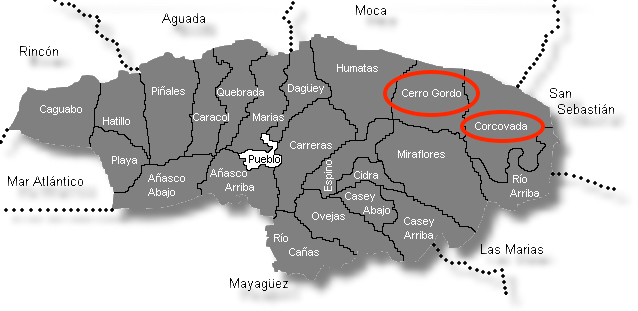
These land purchases now make more sense after finding him listed in the 1872 Registro de Esclavos. Yvonne Santana Rios’ transcription of Anasco and Cabo Rojo portions of the 1872 volume led me back to searching the FamilySearch database ‘Slave Registers, Puerto Rico, 1863 – 1879 ‘. I still have no name for the hacienda that these individuals worked, and know more or less where it was located, in barrio Cerro Gordo, Anasco. Yturrino and his family lived in barrio Corcobada to the east of Cerro Gordo, and later in a house in barrio Pueblo.
Anasco, Puerto Rico. Barrio Cerro Gordo is where formerly enslaved by Yturrino lived; he & his family lived in Barrio Corcobada.
In barrio Cerro Gordo, Anasco, Yturrino enslaved over 20 people, whose cedulas are receipts for the transfer of ownership from the individual slave holders to the colonial government, and they received 120 pesetas per document. The status change to libertos (freedmen or freedwomen) meant rights were established over time.
According to the terms of the Moret Law, these men, women and children entered a contract to work for their former enslavers or for a different plantation owner. They received no pay, but their freedom at the end of three years. For the youngest, this process of manumission lasted until 1886.
Labor: de Esclava/o a Liberta/o
There were a range of tasks, however few were dependent on women becoming domestics in elite households, or took in laundry, or were dress makers. The majority of enslaved women worked as Labradoras, field laborers alongside men. This ran contrary to the ideal of an enslaved person that circulated in prints and paintings, often depicted as male. Men worked as cooks, carpenters and mostly as field laborers in the sugar centrales that grew after the Spanish American war, and women’s labor shifted to the domestic.
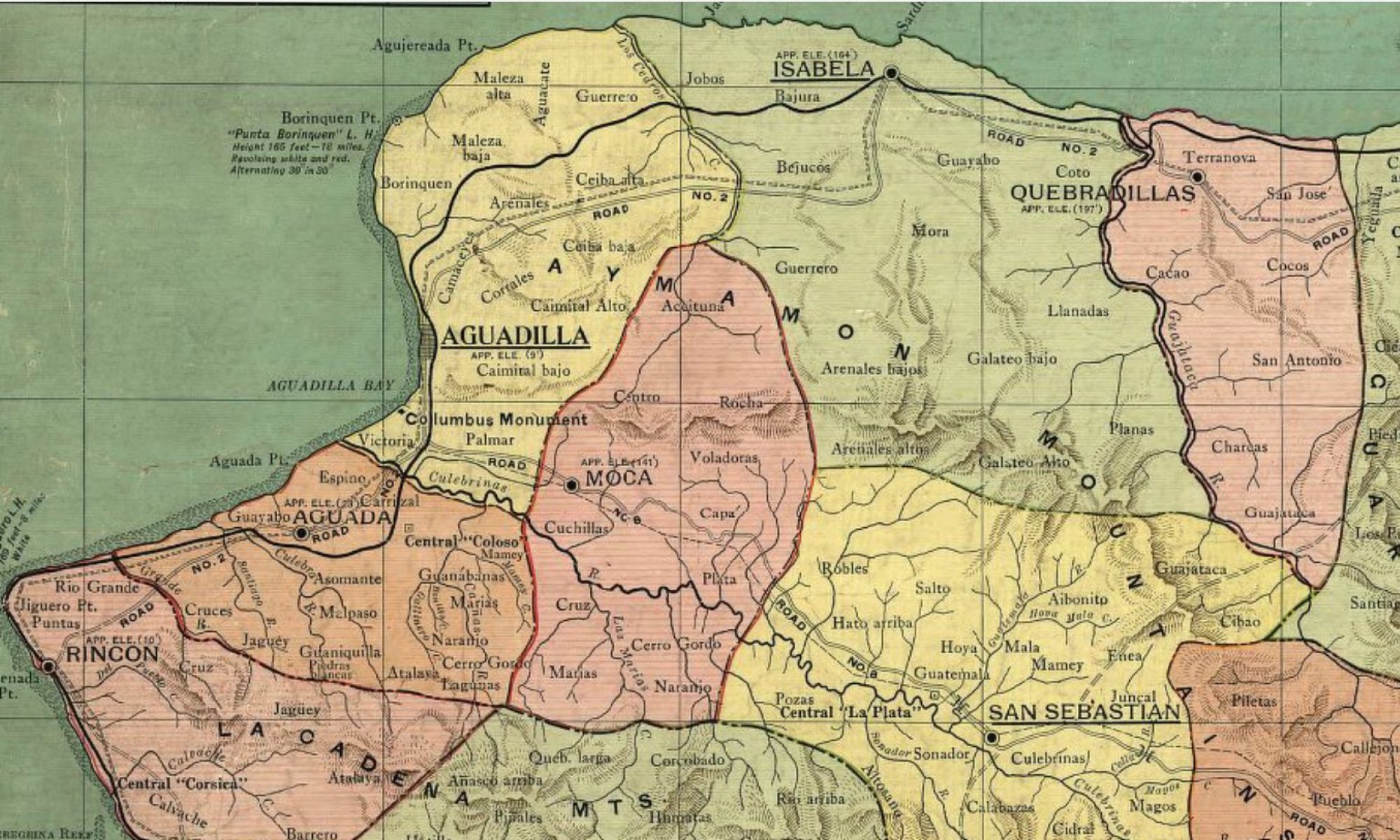
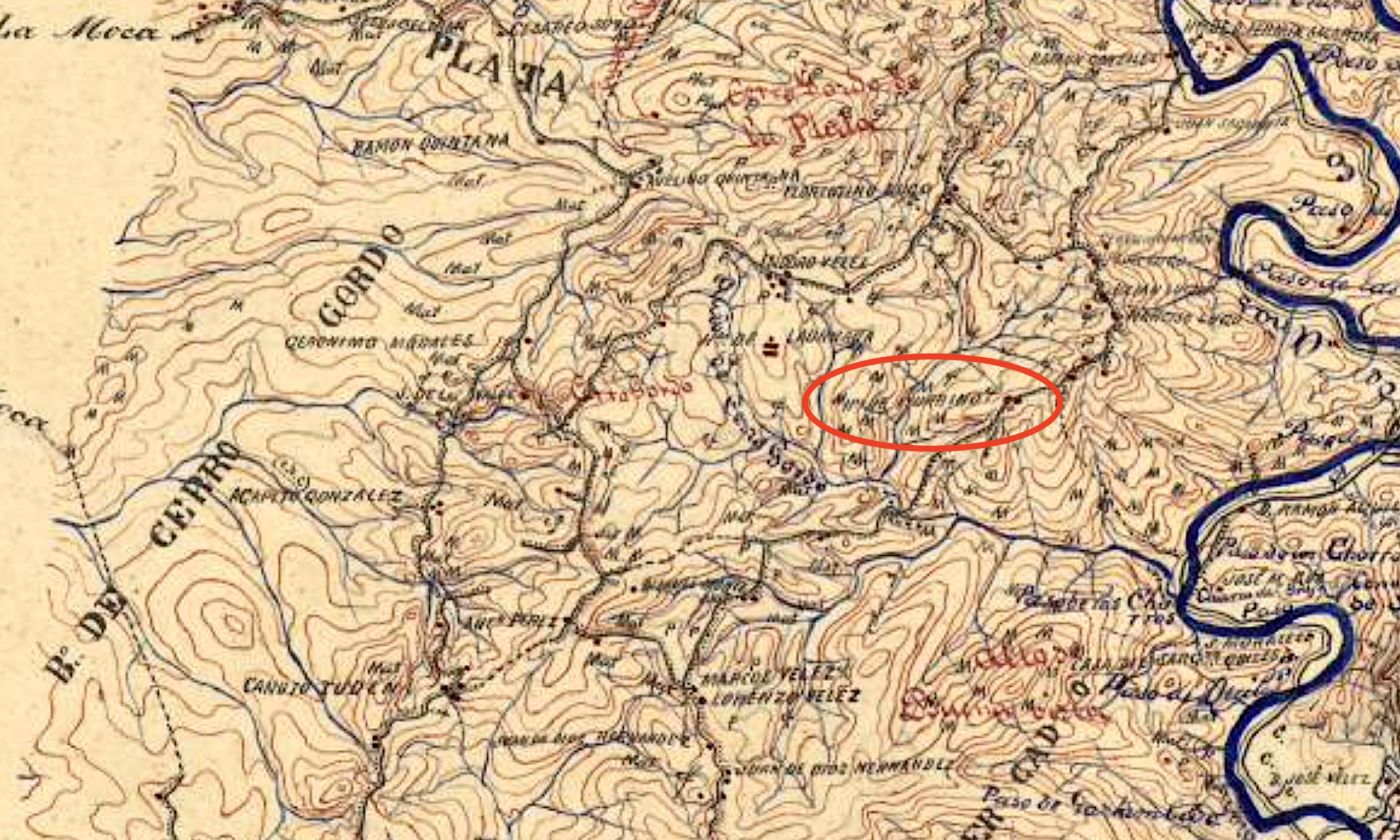
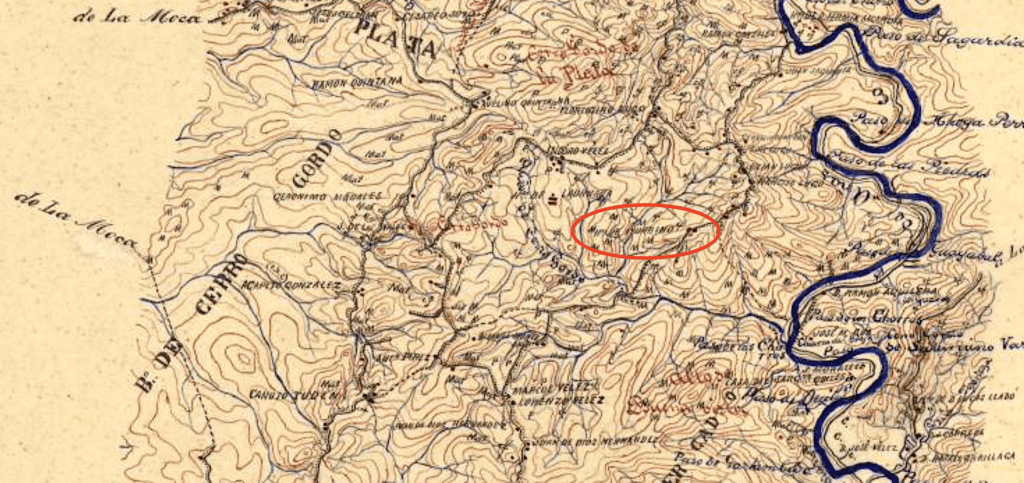
While the categories for labor in the documents for the Registro de Esclavos are few, these do not give a precise idea of the range of tasks that a person had, nor how expert they had become. Cerro Gordo was elevated land, better suited for coffee cultivation, and this is likely the crop that Yturrino’s enslaved workers were raising. Given the patterns of inheritance, there is a high probability that the Hacienda de Iturrino in the 1893 Military Map for Anasco to San Sebastian is the same location as in 1870, situated near the streams in the hills that ran between Anasco and Moca.
Location: Hacienda de Iturrino, Barrio Cerro Gordo, Anasco. Mapa Militar, Itinerario de Añasco a San Sebastián, 1893. ADNPR
Say Their Names: Enslaved families, children, locations
Below is a list of 20 persons listed on cedulas from 1868 on which D. Felipe Yturrino y Arzua appears as dueno (owner). The oldest was Agustin an 80 year old man born in Africa; the youngest was 2 year old Josefa, born in Cerro Gordo, one of the children of Evangelista and Vicenta. Nearly half of those enslaved were children.
The few families I could trace to the Registro Civil opted to take a different surname; not one kept Iturrino as a surname. Some moved to Mayaguez in the years that followed. With the collapse of coffee prices after the 1870s, sugar plantations soon dominated the landscape.
Should these names be familiar to you, please feel free to reach out.
Persons Enslaved by Felipe Yturrino, Barrio Cerro Gordo, Anasco, 14 October 1868. Caja 2, Registro de Esclavos, AGPR, Gob. Españoles, FS Film 008138868
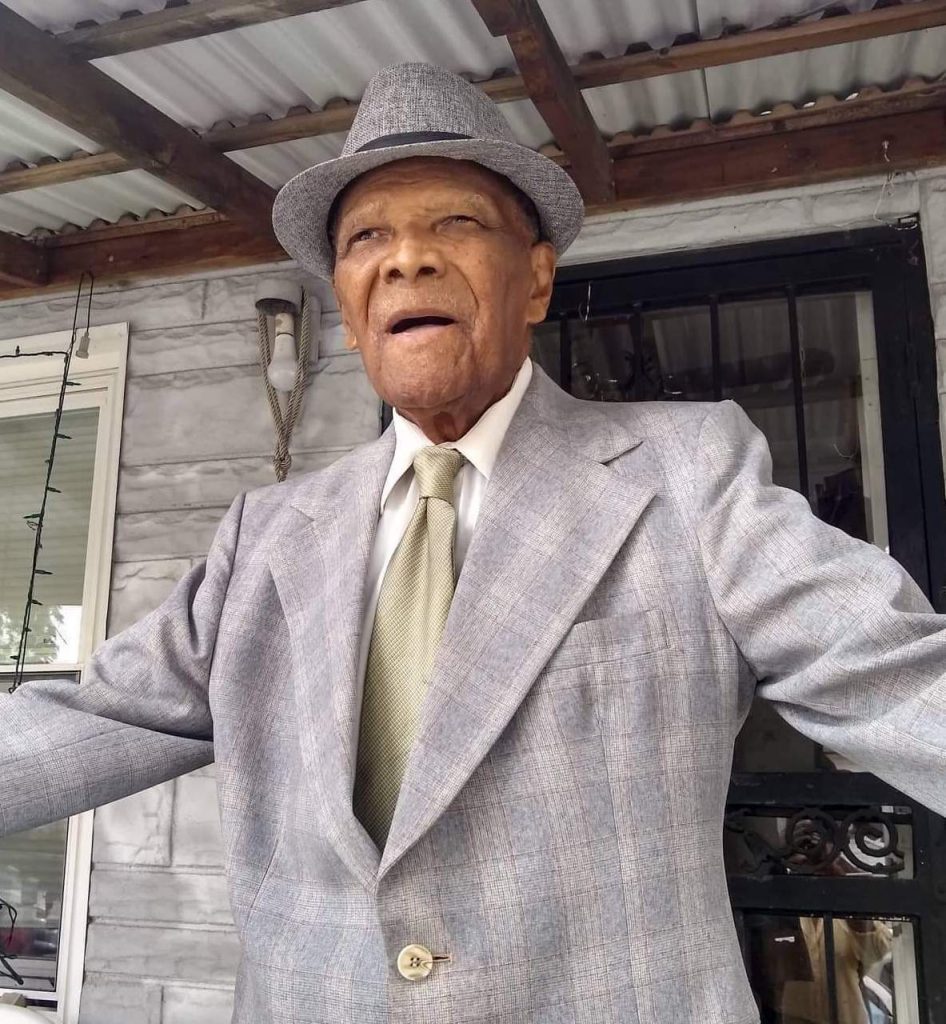
Julio Ester ‘Ulla’ Rivera, November 2021. Photo courtesy of Julio Enrique Rivera.
I’ve finally submitted the materials, tables and text to accompany Part 3 of the Missing Registro Central de Esclavo volume for Northwest Puerto Rico to Hereditas. This set of transcriptions of cedulas are from Caja 2 (item 2) of 1870. The essay focuses on facets of the lives of 55 enslaved people held by Cristobal Benejam Suria or Serra in 1870, a Menorcan who arrived in Puerto Rico about 1817. Other family members were also enslavers. Several Benejam family clusters are traced from the cedula through the Registro Civil and census records, to reconstruct some of their history.
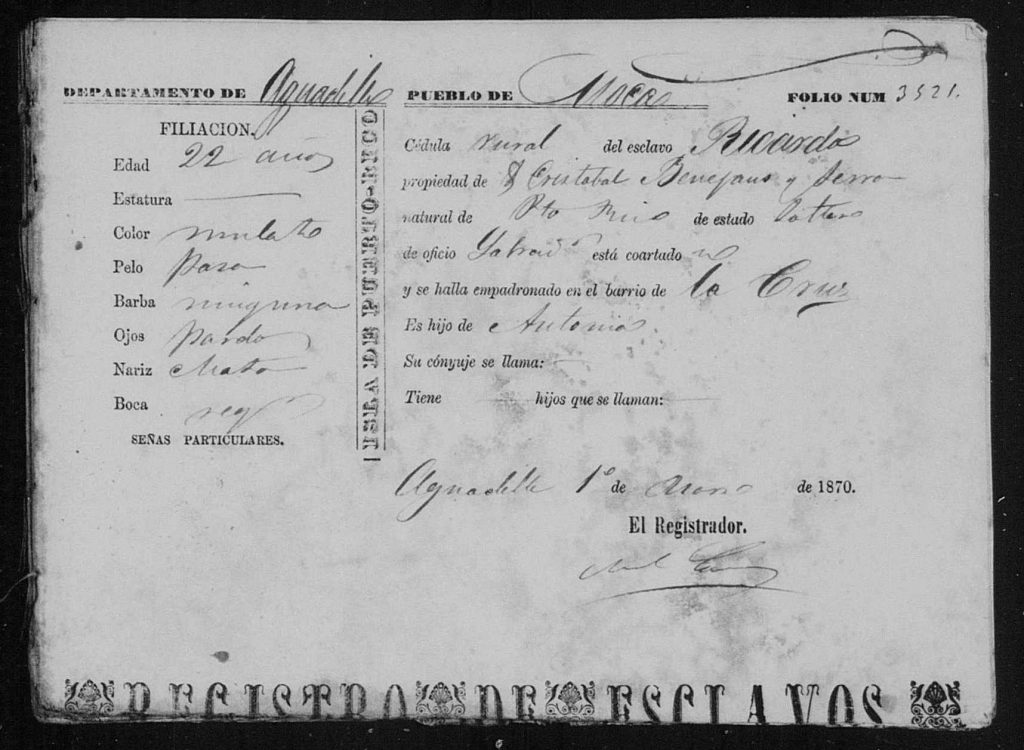
As it turns out, when I mentioned my project to my cousin, Julio Enrique Rivera, he mentioned that his dad, Julio Ester Rivera (looking very dapper in the photo above) was a Benejan. His great grandfather was Ricardo Benejam Vargas (1848-1924) born into slavery, the child of Maria Antonia Vargas and Pedro Benejam. This is Ricardo’s cedula of 1870.
I am struck by how fragmented some of the resources available are.
Some of the documents i’m looking at:
Parish records
Municipal Document series – Censo y riqueza de Moca 1850
Cedulas, Registro Central de Esclavos
Registro Civil
What I wish there were more of for NWPR: census, contracts, notary documents; basically a database that can help descendants pull these fragments together.
As for books & articles, am rereading Benjamin Nistal-Moret’s “The Social Structure of Slavery in Puerto Rico” (1985). I’d like to use the tables as a model for what I am working on, which is information missing from the numbers he is using. This was “the first time in Puerto Rican historiography, an analysis of this magnitude has been completed with a computer.” He tells an interesting story about locating a missing 1872 Registro Central de Esclavos volume at the Library of Congress, microfilming it and returning it during the summer of 1975. As he did his work in the 1980s, his statistical work was entered onto punch cards of a computer program used in sociology. Which volume it was, Nistal-Moret doesn’t say.
I wonder how much archival material was lost, for instance, after the US returned the series of documents of the Gobernadores Espanoles – T1121 Record Group 186- Records of the Spanish Governors of Puerto Rico (impounded on the terms of the Treaty of Paris in 1898) were transferred to the National Archives in 1943 and returned to Puerto Rico by joint resolution in 1957. The microfilm of the Registro de Esclavos and the Registro Central de Esclavos are part of that huge series, and NARA has a free version at the link above.
What I try to do in this series of articles are mini-histories of persons that appear on the 6 x8″ cedulas. Connecting someone in 1870 to their appearance in the Registro Civil that begins in 1885. The process takes time, as there is no mention of enslavement, save in the surname ‘Liberto.’ Some take different surnames, while many kept their enslaver’s name, or took that of a different owner when sold before 1870.
Some of the descendants of Luisa Benejan born about 1819 appear among the cedulas of Caja 4 of the Registro de Esclavos, while three appear in the Registro Civil. She doesn’t turn up on the Registro Civil. Still, the documents together reconstruct her family.
Also reconstructed are early family trees for Pedro Benejam of Moca, born about 1817 in Moca, and who partnered with Maria Antonia Vargas, who lived until 1902 and lived in Bo. Pueblo, Moca. Among their descendants is where my cousin Julio Enrique Rivera’s line connects. The families created after emancipation were often female headed households, with daughters that worked in the local service economy, and sons in agricultural labor.
We must continue to say their names.
References
Ricardo, 22, 3531. Caja 4, Registro de Esclavos, 1867-1876. “Puerto Rico Slave Registers, 1863-1879”, database, FamilySearch (https://familysearch.org/ark:/61903/3:1:3Q9M-CSK3-Z3WY-S?cc=3755445 : 21 October 2021), > image 1 of 1.
Benjamin Nistal Moret, “Problems in the Social Structure of Slavery in Puerto Rico During the Process of Abolition, 1872”. Manuel Moreno Fraginals, Frank Moya Pons & Stanley L. Engerman, eds.Between Slavery and Free Labor: The Spanish Speaking Caribbean in the Nineteenth Century, Baltimore: Johns Hopkins University, 1985, 141- 57.