Thrilled to announce i’ll be presenting along with four other speakers at an upcoming virtual program. The Library Company of Philadelphia’s Program in African American History and the Center for American Art at the Philadelphia Art Museum are sponsoring the event.
My twenty minute talk, “Not Yet Completely Free: Gradual Emancipation and the Family of Moses Williams, Philadelphia, 1776-1830.” presents the results of an archival journey. While I searched for information on Moses Williams, I instead found indentures in the Pennsylvania Abolition Society Papers for his family members that let me reconstruct his family tree. These records show how a Free Black family navigated a difficult economy in the decades before the 1838 census.
This talk draws on my article which appeared in volume 43 of the AAHGS Journal. The Sons and Daughters of the US Middle Passage awarded me the Phillis Wheatley Literary Award this past June for the article.
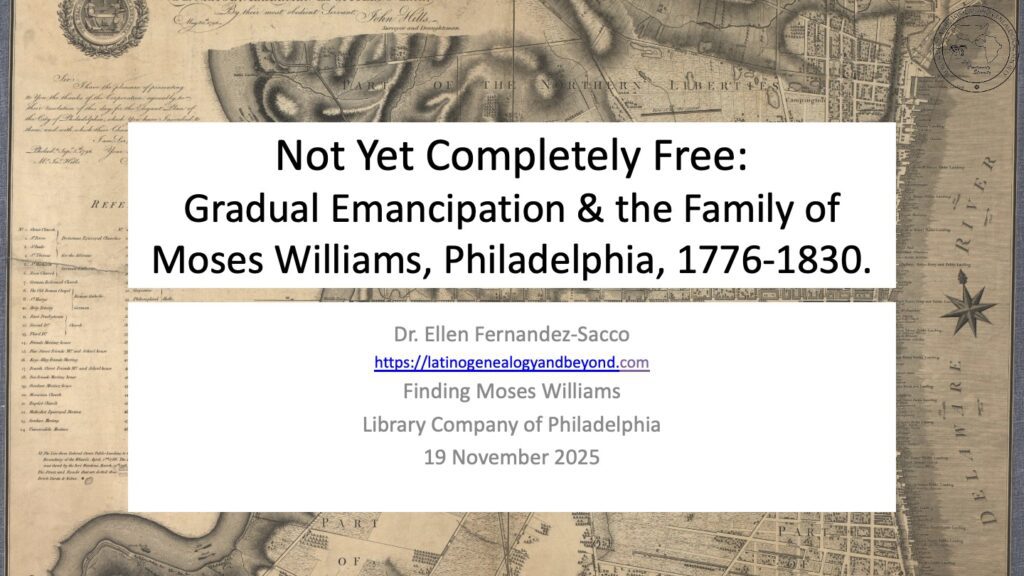
Finding Moses Williams: the program
The other presenters are Carol Soltis, Nancy Proctor, Dean Krimmel, & Lauren Mulvey with an introduction by Sarah J. Weatherwax, Senior Curator, Library Company. Appreciate the knowledge shared & discussed over the preceding months with artists and scholars whose work focuses on Moses Williams. There is much to learn about Williams life, art and family.
Please register at the link below the program description:

Finding Moses Williams
Free Virtual Program
November 19th , 2025 at 1 PM ET
This program of illustrated talks by five speakers focuses on the identification of the exceptional hollow-cut paper profiles created by Moses Williams (1776-1830) at Peale’s Philadelphia Museum and on presenting new historically accurate information about Williams’s life and family. Moses’s parents were manumitted by Peale in 1786 and Moses, who was born enslaved, was then indentured to Peale by his parents until age twenty-eight
Raised within the Peale family, Moses was literate and trained in skills for creating and installing the Museum’s displays of art and natural science. After the installation of a physiognotrace device for creating hollow-cut paper profiles in 1802, Moses was freed and given the concession to operate this new attraction. The popularity of this inexpensive form of portraiture and the highly accurate and elegant profiles Moses cut, made him financially independent.
Recent research into Moses’s life provides us with a clearer understanding of his artistry and other activities, as well as his death date and the identity of his descendants. And, the story of Williams’s birth family illuminates how the practice of indenture used by Free Black families, like the Williams family, was a strategy for seeking financial stability.
A small selection of Moses Williams’s profiles will be on display at the Library Company during November and December and in the Peale Gallery at the Philadelphia Museum of Art.
This program is sponsored by the Library Company of Philadelphia’s Program in African American History and the Center for American Art at the Philadelphia Museum of Art.
Discover more from Latino Genealogy & Beyond
Subscribe to get the latest posts sent to your email.