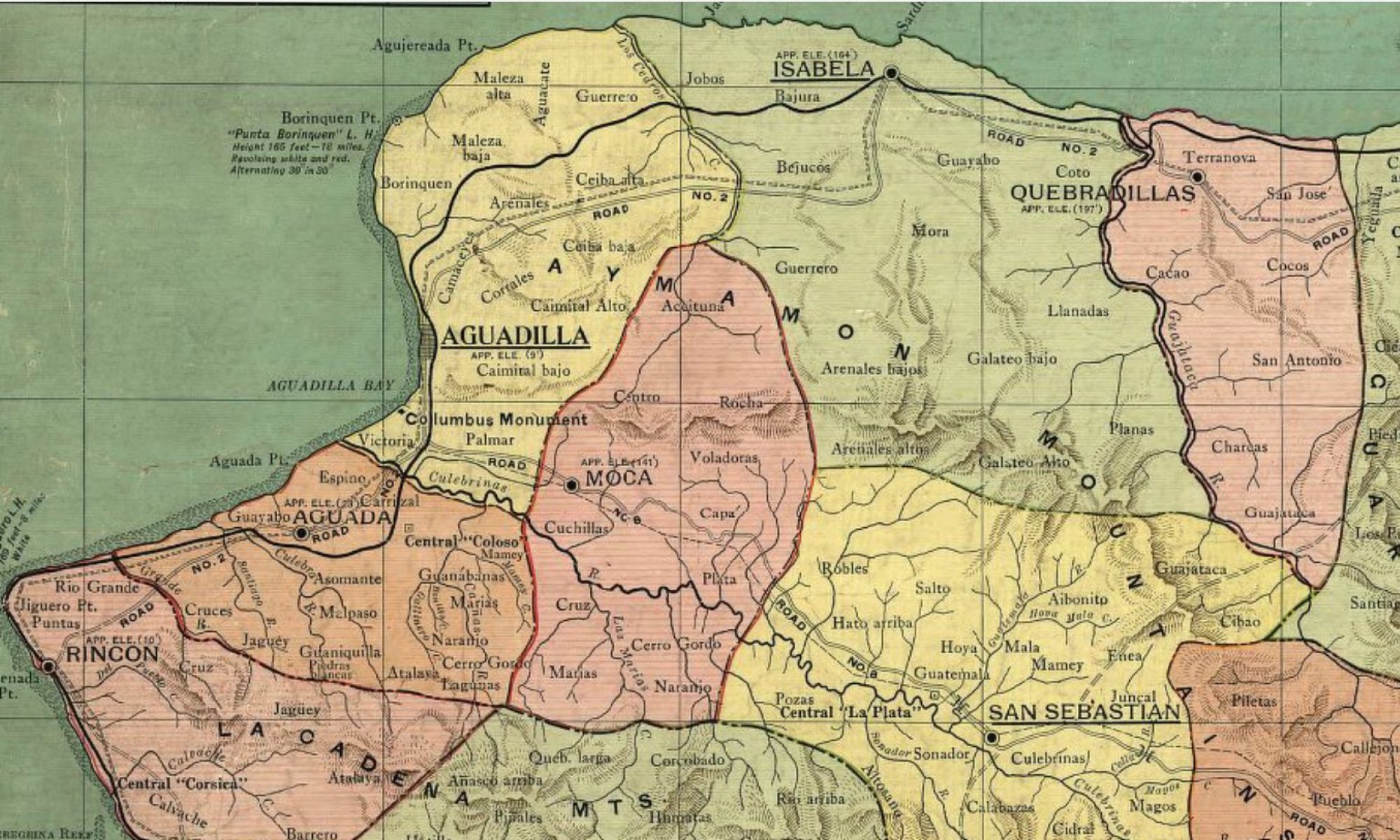

While there are multiple sites and approaches to engaging the past in Puerto Rico, I understand there is no one location that can attest to the variety of experiences that ancestors had as they moved towards freedom. In this excerpt from part 4 of “Reconstructing the Missing Registro de Esclavos for Northwest Puerto Rico”, (Hereditas, 20.2,2024) I consider some of what I learned from attending meetings for different Enslaved Descendant Communities in Virginia to better understand how these gatherings and actions can work in the context of Puerto Rico. It is a privilege to see the work of these amazing groups that preserve the memory of these ancestors while providing access and resources for others who do this work.
Recently, the Municipio de Moca had a questionnaire about what the role of Casa Labadie is, however there was no questions that concerned the past before 1873. This kind of activity would supplement the efforts of the Middle Passage Ceremonies and Port Markers Project and PROPA – Puerto Rican Organization for the Performing Arts.
Enslaved Descendant Communities in the Context of Puerto Rico
At various historical sites today, the many descendants of various enslaved communities are connecting via the pairing of DNA and the digitization of archival materials. This increased access to digitized documents is happening alongside large-scale efforts to collect, preserve and share these experiences and family histories of enslaved descendants. When we consider Northwest Puerto Rico as the site of such activity, the locations linked to trafficking span oceans across a myriad of histories and transactions that creates a lacework of relationships. Clearly there is space for commemoration and memorialization of the lives that passed through the process of enslavement to emancipation over hundreds of years.
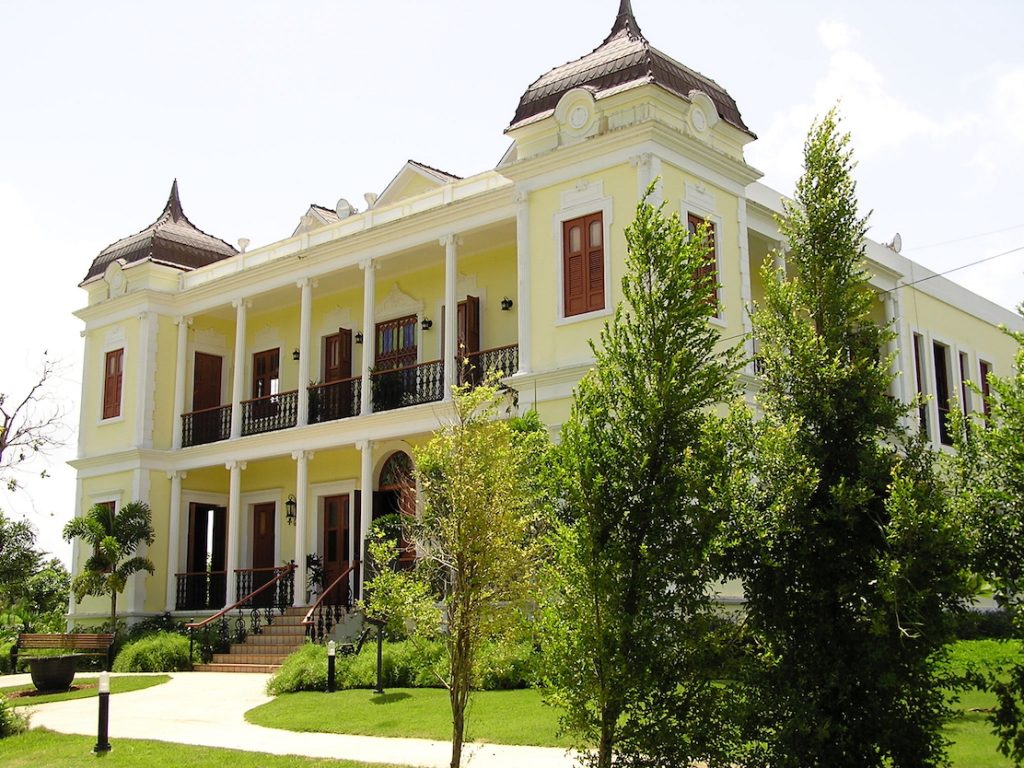
A potential site for a center for Enslaved Descendant Communities is the Hacienda Labadie in Barrio Aceituna, Moca. Once owned by the Pellot family, it was sold to Pedro Labadie, and to his wife, Cecilia who was formerly enslaved there. The original buildings were of wood and rebuilt in a French architectural style in 1903, as it appears today. The history of enslavement at Hacienda Labadie extends a century earlier, when cultivation began to shift to the production of coffee and sugar. Before the rise of sugar cultivation, the barrio was made up of the open pastures of military outposts. Just after 1800, the hato located in Barrio Aceitunas of Moca were subdivided and sold, often to the European emigres who arrived under the Real Cedula de Gracias of 1815.[1] Slavery diversified, and while numbers never approached those of other Caribbean islands, the economic system still relied on enslaved labor.
The development of Enslaved Descendant Communities can provide advantages for families to research their ancestries at different locations and find ways to commemorate, memorialize and explore what reparations mean for descendants today. The descendants of people enslaved by James Madison have organized into The Enslaved Descendant Community for Montpelier. Recently, they held a workshop to explore their options for memorialization of their ancestors who labored there. The results intend to recognize those who labored to create the landscape of Montpelier, whether it was those whose skills built the buildings, or those who worked at the big house in a variety of capacities or tended the fields of this plantation. This process offers a means to a fuller and more complex story of the site.
How to Proceed: The Rubric as Model
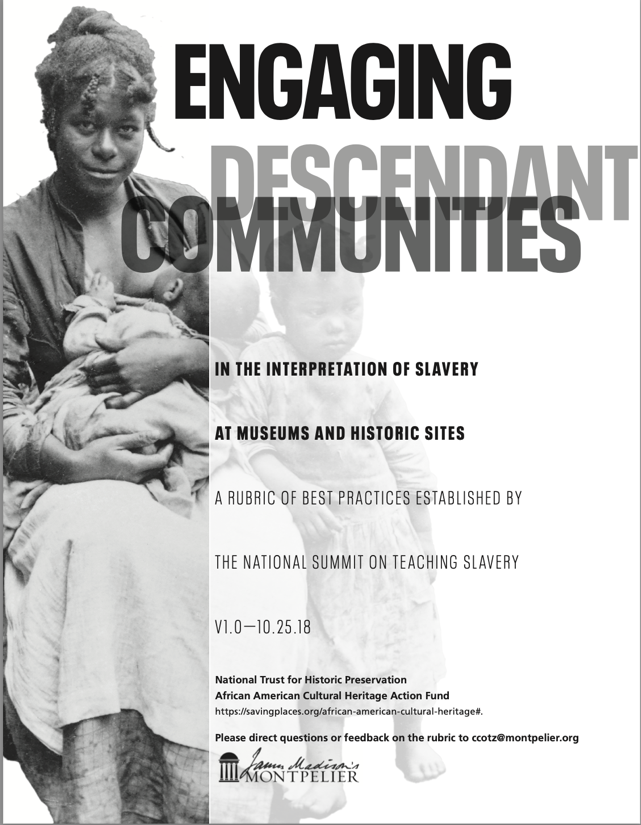
Fig 22: Cover, Engaging Descendant Communities in the Interpretation of Slavery at Museums and Historic Sites: A Rubric of Best Practices. (2018)
What Montpelier’s Enslaved Descendant Community uses as a blueprint for mapping potential projects together is a document called ‘The Rubric’ short for Engaging Descendant Communities in the Interpretation of Slavery at Museums and Historic Sites: A Rubric of Best Practices. [2]
The Introduction opens with why this is necessary work:
“What is the ideal relationship between descendent communities and institutions that interpret slavery? Historically, the relationship between these two groups is complicated: many institutions have avoided interpreting slavery, often from fear of estranging donors or visitors. While these fears are valid, by not interpreting the lives of the enslaved, institutions fail to tell a complete story. This failure perpetuates historical and ongoing trauma to the descendants of those enslaved there, and to anyone whose ancestors were brought to the Americas during the transatlantic slave trade. When institutions shy away from creating relationships with descendants, the failure speaks volumes to the descendant community, especially as these institutions continue to profit from their ancestors’ labor and pain.”[3]
The enslaved people who provided the labor of plantations, farms and surrounding haciendas have had only passing acknowledgement over time — mostly as a class of enslaved workers rather than as a community with a shared experience in slavery.
By making their participation visible, the historical narrative told can refocus on various aspects such as the law, architecture, even cultural trends that worked to constrain and expand their lives. Part of this shift “goes to the heart of genealogical practice regarding the ways that the families of enslaved people were documented. How do we record those enduring social links that existed despite their designation as mobile forms of property?” As genealogical practice undergoes desegregation, newer methodologies develop that can take advantage of what oral history, community history and DNA can offer. While some of this activity is taking place online, access to records and a need for training others on working with these document sets is needed so that communities can find their ancestors and ancestral kin. In turn, this process can continue to generate a better understanding of this past, its generational traumas and its profound resilience.
Conclusion
My hope is that these initial family narratives show that there are many connections that can be made between the document sets produced through the process of emancipation- registration forms, census, municipal documents, parish records and the Registro Civil. There are some for whom an extensive tree can be constructed, and others, like the newborns inscribed by Laguerre, have no parent listed. Regardless, these documents lend visibility to the strategies and relationships that helped these communities survive. As social beliefs shift, these narratives serve as a confirmation of history and humanity, rather than a framework for a social problem.[14] A plantation has multiple histories, not simply those of its owners.
The process of forming Enslaved Descendant Communities in Puerto Rico at historic sites can work as an opportunity for connection and development. Increasingly, people who are DNA testing are finding matches tied to Puerto Rico and are also seeking these ancestors. The coming years will see an increase in projects such as Enslaved Descendant Communities that combine digitization with archival materials to produce a fuller understanding of a past that connects so many ancestors, beyond the boundaries of Boriken. May we continue to learn their histories, may they rest in peace and power.
[1]For more on Pellot and the rise of Hacienda Labadie, see Ellen Fernandez-Sacco “Reconstructing the Missing Registro de Esclavos Pt.1” Hereditas, 20.2, 2019, 68-90. https://www.academia.edu/49048096/Reconstructing_District_3s_Missing_1872_Registro_Central_de_Esclavos_Part_1
[2] The Rubric: Deliverable from the 2018 National Summit on Teaching Slavery. Montpelier Descendants.org https://montpelierdescendants.org/rubric/
[3] Engaging Descendant Communities in the Interpretation of Slavery at Museums and Historic Sites: A Rubric of Best Practices. https://montpelier-documents.s3.amazonaws.com/Interpreting%20Slavery%2011-12-19.pdf
[4] E. Fernandez-Sacco, “Bound to History: Leoncia Lassalle’s Slave Narrative from Moca, Puerto Rico, 1945.” Genealogy, 2020 4:93, 20. https://www.mdpi.com/2313-5778/4/3/93