What do you do when you find ancestors who bear the exact same name?
This two part blog post is about Bibiana Caban Mendez, one of three women who carried the same name and sorting which one was which. Many have Caban in their trees, along with endogamy that continues for generations. You can descend from Caban who lived on the land and got their name that way, or had ancestors enslaved by different branches of the Caban family. You may find that these lines are blurred, rather than align with boundaries of caste. Some have Irish roots, others African, AfroIndigenous, most have been on the island for centuries. It is truly a surname que tiene de ‘to.
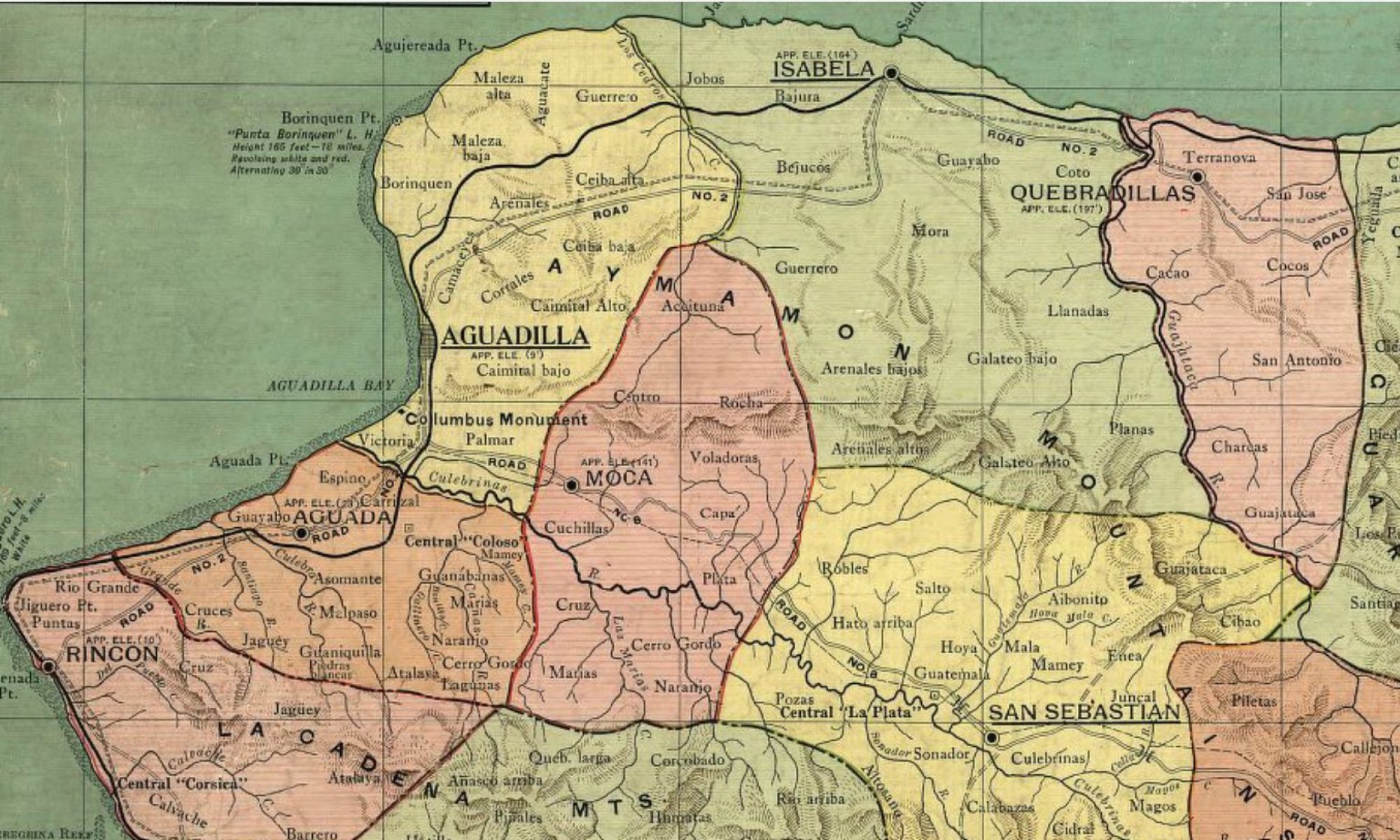
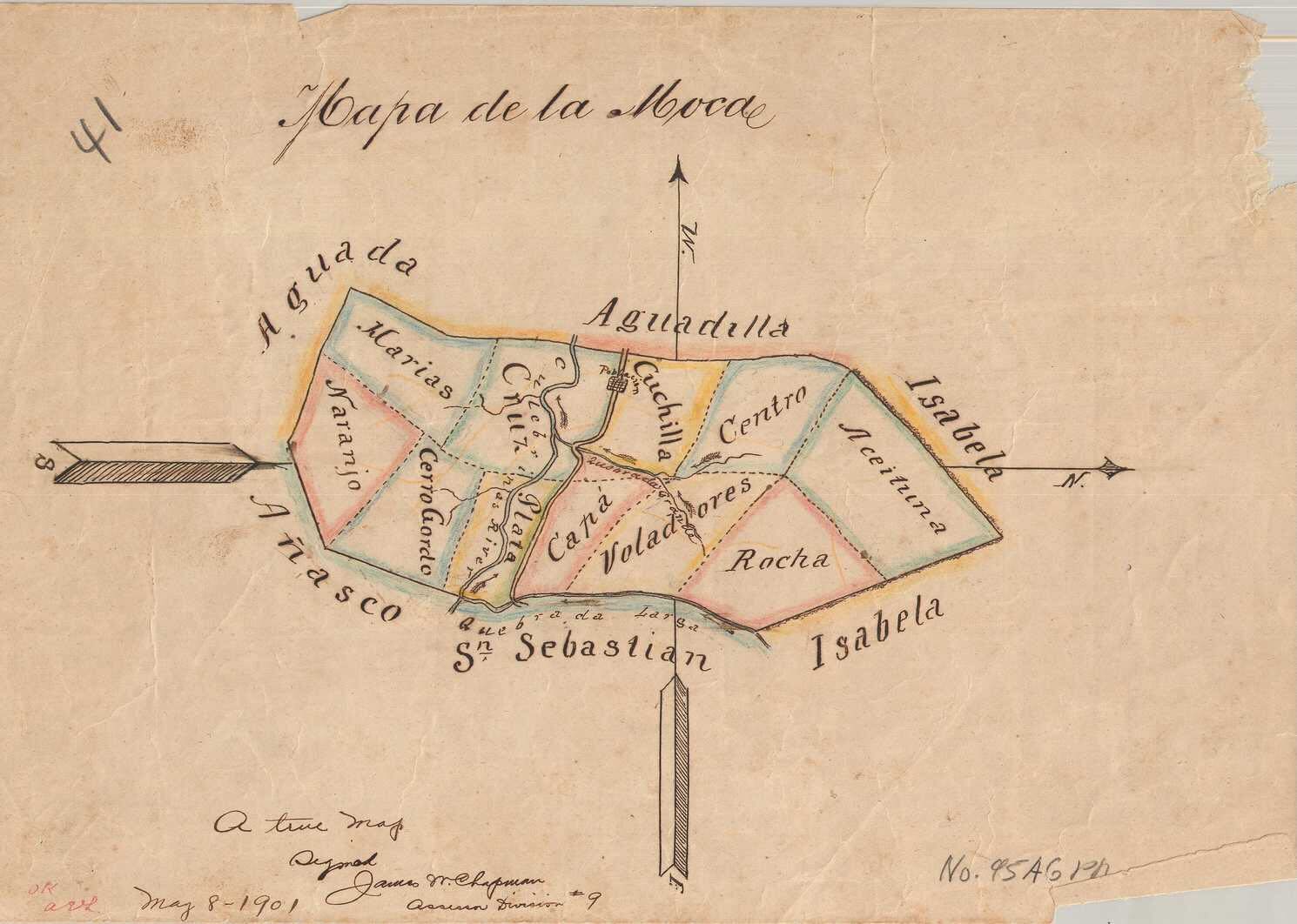
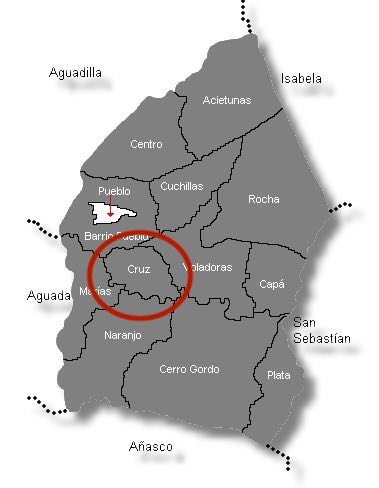
This first post is on Bibiana Caban Méndez who lived in Barrio Cruz, Moca, Puerto Rico from 1859-1921.
A death in the family
On the second of July 1921, Bernardo Medina arrived at the office of the Registro Civil in Barrio Pueblo, Moca to report the death of his mother in law, Bibiana Caban Mendez in Barrio Cruz. She died at one o’clock in the morning after struggling with a bout of broncopneumonia. He gave her parents names, Prudencio Caban and Crecencia Mendez, both deceased. Medina didn’t know the names of her maternal and paternal grandparents.
The document doesn’t specify which daughter the Declarante Bernardo Medina was married to. We know from other documents that Bernardo Medina Caban married Gregoria Mendez Caban, Bibiana’s daughter.
But wait, is this Bibiana Caban Mendez the same person who married Aurelio Charneco Caban? Or was this someone else completely? During the mid-nineteenth century, there were three Bibiana Caban Mendez in Moca. Six more Caban women who bore the name.
Which Bibiana?
I began drafting this post after falling into a Babilonia rabbit hole a year ago. I wound up working on connected lines seeking to correct some of the gaps I had in the tree. While researching on Ancestry, I saw a few online trees have a Bibiana Caban, but not the right one for their line. One tree linked to a Bibiana Caban Babilonia, a later, distant connection. This research faces challenges that overlap with undigitized parish records unavailable for research.
My connection to Bibiana is not direct at the moment. The link is through her husband’s Mendez del Rosario line that lead back to my 6th GGPs. A potential connection is likely to come from her father Prudencio’s Caban side. As there’s lots of endogamy, there are many Caban connections today. Are you among the many Caban cousins of NW PR?
Bibiana was a popular name among the Caban family, as my database contains 9 women born in the mid-nineteenth century who bore the name. There were Maria Bibiana, Balbina Bibiana and Francisca Federica Bibiana and only 3 who were just ‘Viviana’. Bibiana Caban Mendez mostly appears as Bibiana, and infrequently as Viviana.
Caban, Caval, Cabal
Several Caban lines exist in Northwest Puerto Rico, beginning as Cabal or Caval or Caban in the early 1700s. The surname was inherited, acquired or imposed by slavery.
The first recorded Cabal is Joseph Cabal, 30, from Havana, Cuba. A military man, Cabal settled in Aguada in 1721, according to Dr Andres Mendez Munoz. [1] This is the beginning of the Caban surname in the Northwest. At some point, many descendants can connect back to him and persons the family enslaved. Bibiana began her family at a time when the process of emancipation was taking place in Puerto Rico.
Bibiana Caban Méndez (1859-1921)
Bibiana (or Viviana) Caban Mendez’s (1859-2 Jul 1921) husband was Manuel Monserrate Mendez Acevedo. They probably married about 1872, or early 1873, months before the birth of their first child, Vicente Mendez Caban in December 1873.
Bibiana and Manuel Monserrate share the Mendez surname. Did the couple initiate a dispensation for permission to marry in the Catholic Church? They probably married in Iglesia Nuestra Señora de la Monserrate in the center of Moca’s Barrio Pueblo. I’ll be contacting the Archivo Diocesano for more infomation soon .
Bibiana had 9 children with Manuel Monserrate Mendez. His death preceded hers by almost two decades. She lived in Barrio Cruz.
Her death record makes no mention of their children, like some Actas de Defuncion. Bibiana’s declarante was her son in law, Bernardo Medina Caban. He did not know the names of her paternal or maternal grandparents.
Acta de Defuncion, Bibiana Caban Mendez, Moca, 10 July 1921
Here’s Bibiana Caban Mendez’ death record:
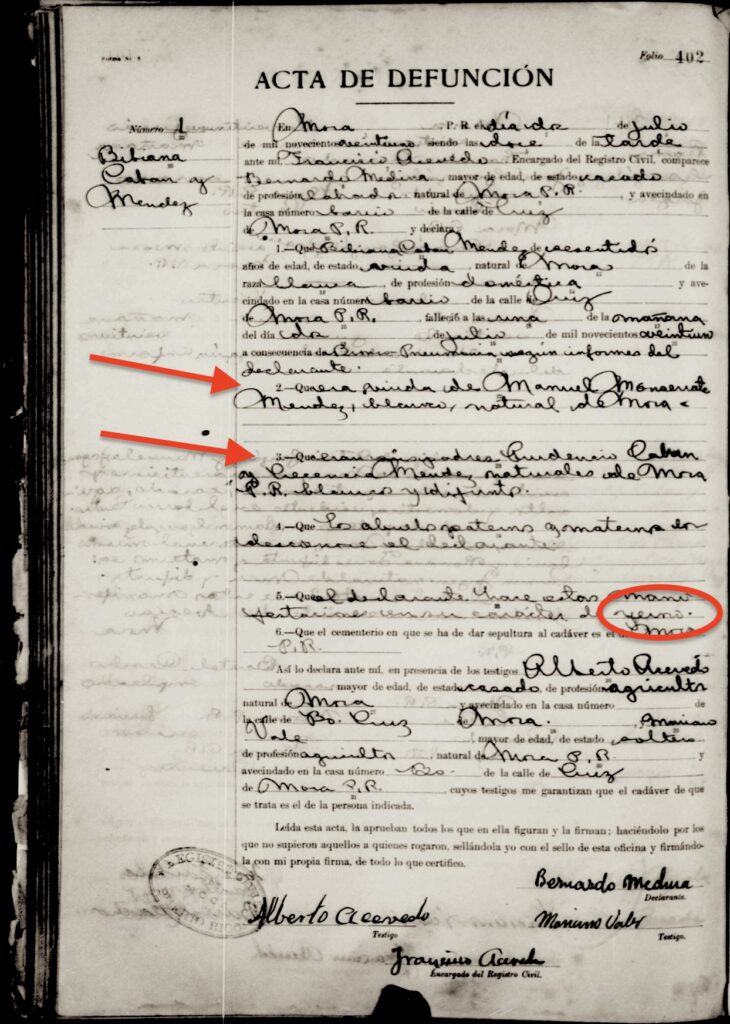
Transcription:
L F402 #1 im 2017
Bibiana Caban Mendez 2 Jul 1921
Declarante: Bernardo Medina, casado, labrador, Bo. Cruz, yerno
Causa: broncopneumonia; viuda Manuel Monserrate Mendez, blanco, nat Moca
hl Prudencio Caban & Crecencia Mendez, blancos, difuntos
abuelos paternos y maternos se desconoce
Testigos: Alberto Acevedo, Mariano Vale
Encargado Reg Civil: Francisco Acevedo
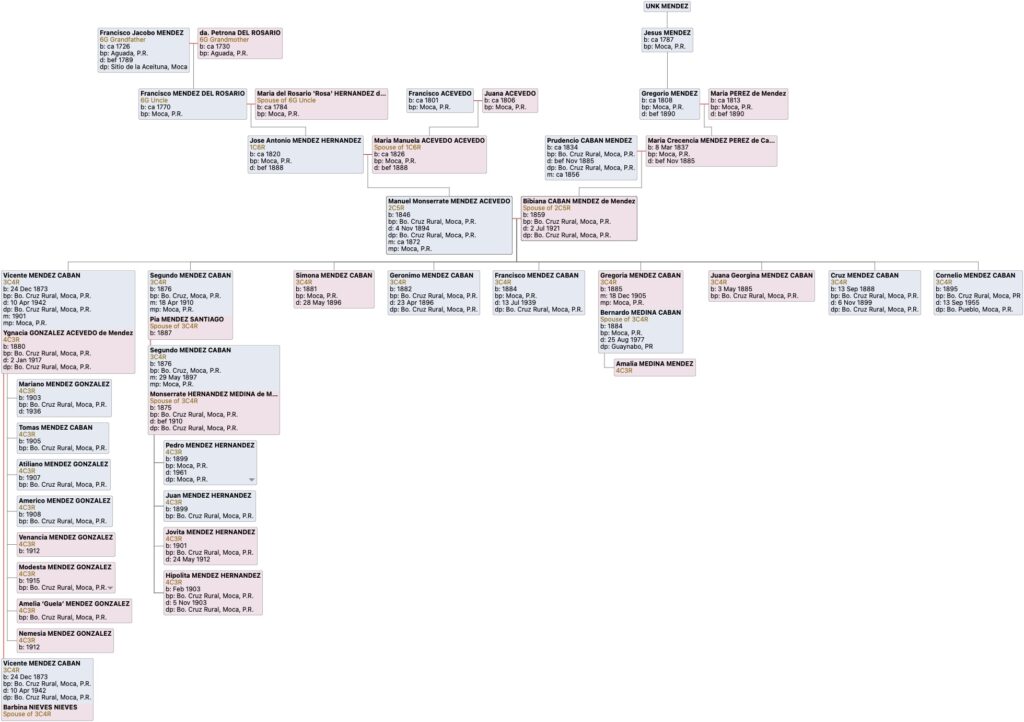
The death record does not list Bibiana’s nine children. The children do appear on her husband Manuel Monserrate Mendez’s death record of 4 November 1894: Vicente, Geronimo, Segundo, Francisco, Juana Lucia, Juana, Cornelio, Gregoria y Cruz Mendez Caban. All were born in Barrio Cruz.
Her parents died before the Registro Civil started in 1885. The lack of records for Prudencio Caban Mendez makes it difficult to pair him with the right Caban Mendez branch further back. Bibiana’s mother, Maria Crecencia Mendez Perez, was one of 4 daughters of Gregorio Mendez and Maria Perez; thanks to notes from an 1876 dispensation, we have the name of Gregorio’s father: Jesus Mendez. Was he also Mendez del Rosario?
Manuel Monserrate Mendez (1846-1894)
Bibiana’s husband was the son of Jose Antonio Mendez Hernandez and Maria Manuela Acevedo Acevedo. Both die before 1888, and were born sometime in the 1820s. Jose Antonio’s parents, Francisco Mendez del Rosario and Maria del Rosario ‘Rosa’ Hernandez only had two sons, Carlos and Jose Antonio. Carlos also married a Caban, Juana Nepomucena Caban Hernandez in Quebradillas on 16 January 1832 and, unlike his parents, they had 16 children. Bibiana’s sister Baudillia, born in Moca, moved to Quebradillas and had a family there. What was it that prompted these branches to move east? Bibiana Caban Mendez remained in Moca.
Marriage & some inconvenient details
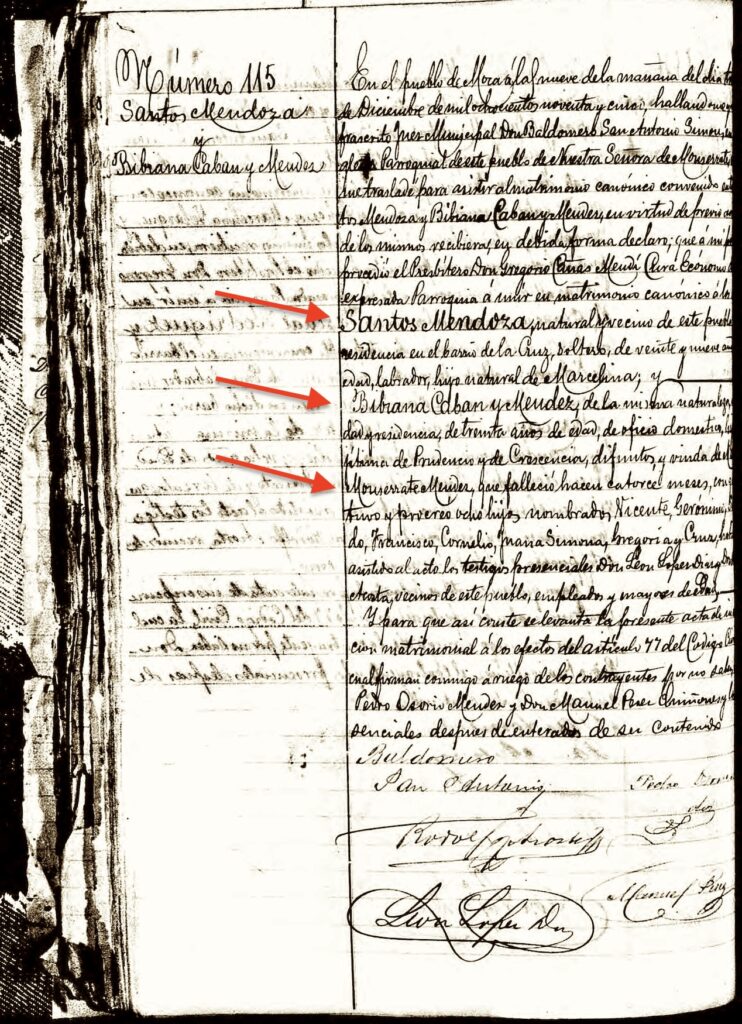
Fourteen months after Manuel Monserrate Méndez died, and left caring for a household of young children, Bibiana remarried. Just before the New Year, she wed Santos Mendoza, living in Barrio Cruz on 30 December 1895 . His name and place of birth has a number of variations over the census and documents in the Registro Civil- as Santos Mendoza or Santos Rodriguez Mendoza, from Aguada. When one compares the details it’s evident he’s the same person. At some point, their relationship doesn’t work out.
In December 1919, Santos claimed he was a widower. Under the name Santos Rodriguez Mendoza, he married Marcelina Barreto Vargas, 48, daughter of Mateo Barreto and Zoila Vargas at the Catholic church in Isabela. Listed as deceased is his mother Marcelina Mendoza, as is his father, Bernardo Rodriguez. The woman Santos married next, Marcelina Barreto, was also a widow.
Marcelina Barreto Vargas (1870-1943)
Marcelina’s previous spouse was Tomas Jose Rivera Reyes, whom she married in 1912; it lasted 7 years. Perhaps due to her age or for another reason, the couple had no children.
The 1920 census records her work as a lavandera, a laundress in a private home. When Marcelina’s partner died in 1919, Tomas Jose Rivera’s occupation was an artesano. He could have produced any range of items for the community, such as wood carvings of santos, religious medals, musical instruments, jewelry, etc. I wonder what Tomas Jose produced and the materials he used.
Before Tomas, Marcelina had a relationship with Estanislao Sosa, (about 1866- before Oct 1904), son of Ramona Sosa Martinez (ca 1846). The couple had 4 children between 1895-1901, two of whom survived childhood.
In mid-December 1919, Marcelina took her chances and married again, this time to Santos Rodriguez Mendoza, viudo de Bibiana Caban Méndez. At the very least, Bibiana was living her life without Santos, and she dies a few years later. Who knew?
What the census shows…
Revealed the following year, is an arrangement for starting over. While Santos Mendoza declared himself a widower, his previous wife, Bibiana Caban Méndez is still alive at this time– she appears as a widow in the 1920 Federal Census in Moca.
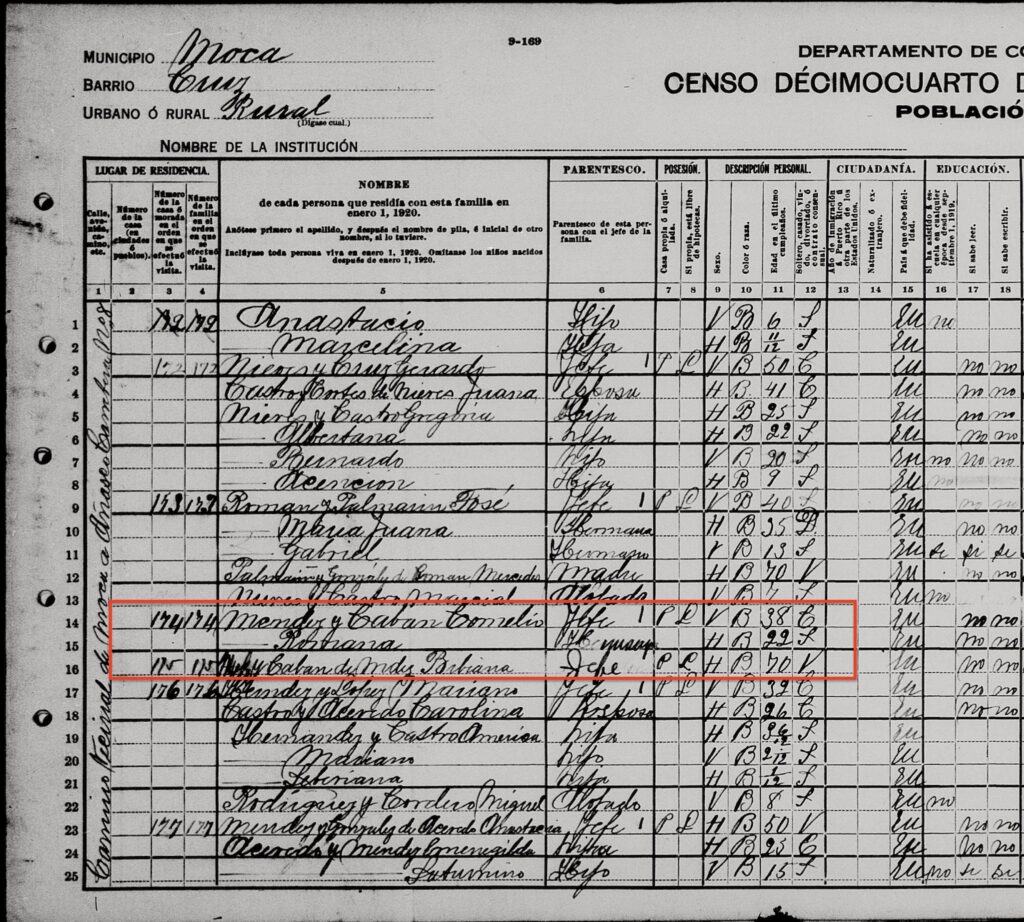
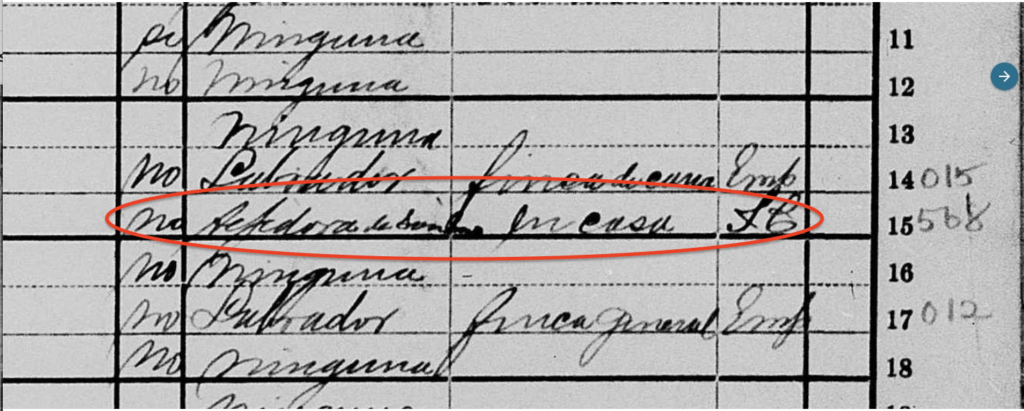
Bibiana had one daughter with Santos– Maria Romana Rodriguez Caban, who solved the problem of which surname to use from her parents overlapping relationships. She simply appears as ‘Romana Méndez’ across several census records. She worked at home as a tejedora de sombreros, weaving hats, por su cuenta, while her brother worked as a laborer on a sugar cane farm; her mother did not work and according to the census, lived alone.
Instead of Santos and Bibiana opting for divorce, which became available after the Spanish American War, they found another, cheaper solution: a move out of town and declaring the previous partner dead in official documents.
Out of sight, out of mind.
References
[1] “El inmigrante de apellido Caban/Cabal de la region de Aguada lo fue Joseph Cabal natural de La Habana Cuba. Dijo tener 30 años en el 1721. Certificación del alférez Juan Ortiz de la Renta alcalde ordinario. San German, 14 de enero de 1721.” Archivo General de Indias. Escribanía de Cámara 129A. Andres Mendez Munoz, Revista de la SPG 2007 No. 1.
“Puerto Rico, Registro Civil, 1805-2002”, FamilySearch (https://www.familysearch.org/ark:/61903/1:1:QVJC-17WV : Wed May 14 06:30:16 UTC 2025), Entry for Santos Rodriguez Mendoza and Marcelina Barreto Vargas.
“Puerto Rico, Registro Civil, 1805-2002”, FamilySearch (https://www.familysearch.org/ark:/61903/1:1:QVJD-VJZL : Wed May 14 06:39:16 UTC 2025), Entry for Romana Rodríguez Méndez and Santos Rodríguez, 23 Aug 1980.
“United States, Census, 1920”, FamilySearch (https://www.familysearch.org/ark:/61903/1:1:X97T-81P : Sat Jan 18 12:33:59 UTC 2025), Entry for Santos Rodriguez Y Mendoza and Marcela Barreto Y Vargas De Rodriguez, 1920.
“Puerto Rico, Registro Civil, 1805-2002”, FamilySearch (https://www.familysearch.org/ark:/61903/1:1:QVJ4-7926 : Wed May 14 06:10:52 UTC 2025), Entry for Tomás José Rivera y Reyes and Marcela Barreto y Vargas.
Matrimonios (Marriages), Isabela, Matrimonios 1916-1932, v. 2-6, v1 https://www.ancestry.com/search/collections/9100/records/122307020?tid=71439239&pid=132704194957&queryId=fe972ed2-0c00-45d5-a7bc-3f499444cc31&_phsrc=GNO1327&_phstart=successSource
“United States, Census, 1920”, FamilySearch (https://www.familysearch.org/ark:/61903/1:1:X9W7-SSB : Mon Jan 20 14:53:18 UTC 2025), Entry for Cornelio Mendez Y Caban and Romana Mendez, 1920.