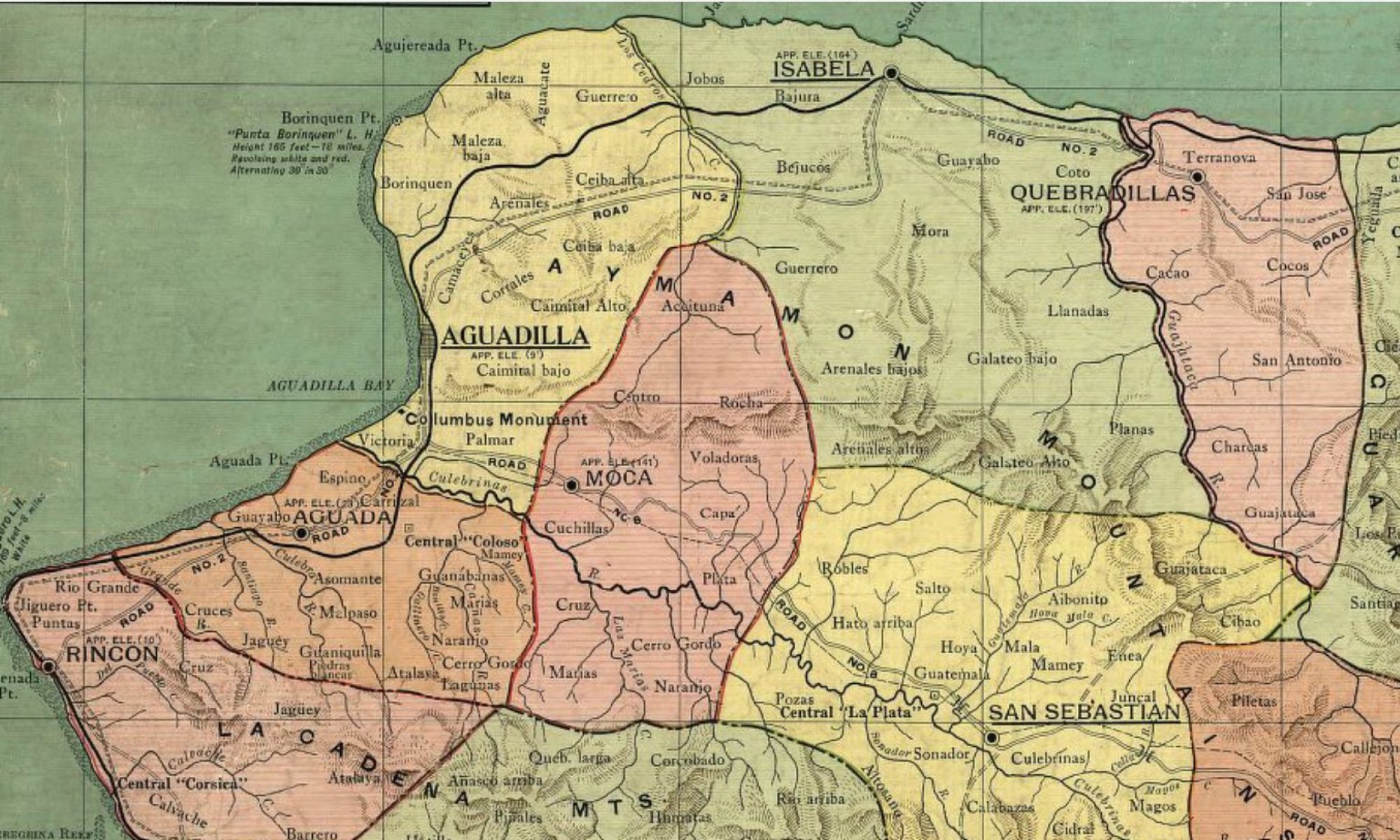
Hacienda Labadie: A Center for Enslaved Descendant Heritage

Hacienda Labadie, Moca, P.R.

While there are multiple sites and approaches to engaging the past in Puerto Rico, I understand there is no one location that can attest to the variety of experiences that ancestors had as they moved towards freedom. In this excerpt from part 4 of “Reconstructing the Missing Registro de Esclavos for Northwest Puerto Rico”, (Hereditas, 20.2,2024) I consider some of what I learned from attending meetings for different Enslaved Descendant Communities in Virginia to better understand how these gatherings and actions can work in the context of Puerto Rico. It is a privilege to see the work of these amazing groups that preserve the memory of these ancestors while providing access and resources for others who do this work.

Recently, the Municipio de Moca had a questionnaire about what the role of Casa Labadie is, however there was no questions that concerned the past before 1873. This kind of activity would supplement the efforts of the Middle Passage Ceremonies and Port Markers Project and PROPA – Puerto Rican Organization for the Performing Arts.

Enslaved Descendant Communities in the Context of Puerto Rico

At various historical sites today, the many descendants of various enslaved communities are connecting via the pairing of DNA and the digitization of archival materials.  This increased access to digitized documents is happening alongside large-scale efforts to collect, preserve and share these experiences and family histories of enslaved descendants.  When we consider Northwest Puerto Rico as the site of such activity, the locations linked to trafficking span oceans across a myriad of histories and transactions that creates a lacework of relationships. Clearly there is space for commemoration and memorialization of the lives that passed through the process of enslavement to emancipation over hundreds of years. 
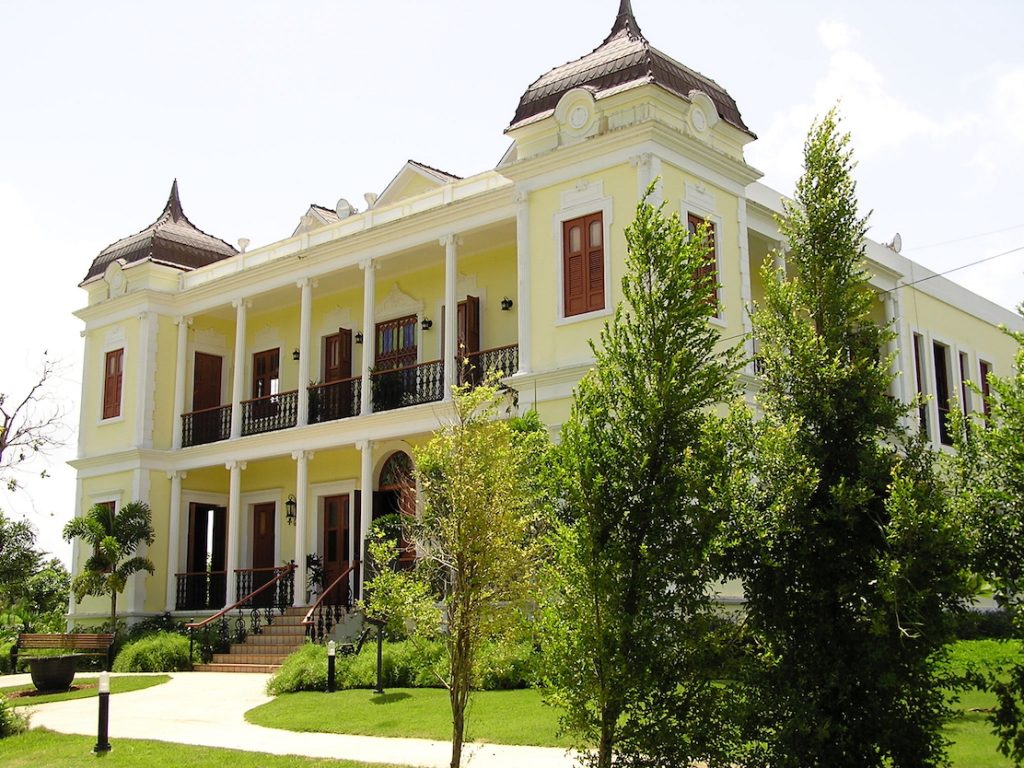
Hacienda Labadie, Moca, P.R.
Hacienda Labadie, Moca, PR. Front of main building, Barrio Aceitunas, Moca, P.R. Photo: EFS, 2007

      A potential site for a center for Enslaved Descendant Communities is the Hacienda Labadie in Barrio Aceituna, Moca. Once owned by the Pellot family, it was sold to Pedro Labadie, and to his wife, Cecilia who was formerly enslaved there. The original buildings were of wood and rebuilt in a French architectural style in 1903, as it appears today. The history of enslavement at Hacienda Labadie extends a century earlier, when cultivation began to shift to the production of coffee and sugar.  Before the rise of sugar cultivation, the barrio was made up of the open pastures of military outposts. Just after 1800, the hato located in Barrio Aceitunas of Moca were subdivided and sold, often to the European emigres who arrived under the Real Cedula de Gracias of 1815⁠.[1]  Slavery diversified, and while numbers never approached those of other Caribbean islands, the economic system still relied on enslaved labor. 

The development of Enslaved Descendant Communities can provide advantages for families to research their ancestries at different locations and find ways to commemorate, memorialize and explore what reparations mean for descendants today.   The descendants of people enslaved by James Madison have organized into The Enslaved Descendant Community for Montpelier. Recently, they held a workshop to explore their options for memorialization of their ancestors who labored there. The results intend to recognize those who labored to create the landscape of Montpelier, whether it was those whose skills built the buildings, or those who worked at the big house in a variety of capacities or tended the fields of this plantation. This process offers a means to a fuller and more complex story of the site.

How to Proceed: The Rubric as Model
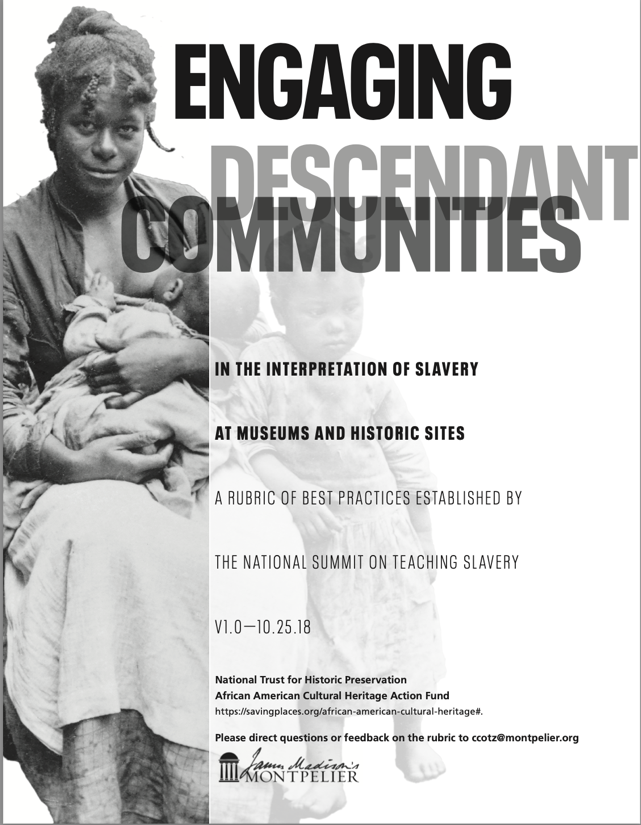
Fig 22: Cover, Engaging Descendant Communities in the Interpretation of Slavery at Museums and Historic Sites: A Rubric of Best Practices. (2018)

What Montpelier’s Enslaved Descendant Community uses as a blueprint for mapping potential projects together is a document called ‘The Rubric’ short for Engaging Descendant Communities in the Interpretation of Slavery at Museums and Historic Sites: A Rubric of Best Practices. [2] 

The Introduction opens with why this is necessary work: 

“What is the ideal relationship between descendent communities and institutions that interpret slavery? Historically, the relationship between these two groups is complicated: many institutions have avoided interpreting slavery, often from fear of estranging donors or visitors. While these fears are valid, by not interpreting the lives of the enslaved, institutions fail to tell a complete story. This failure perpetuates historical and ongoing trauma to the descendants of those enslaved there, and to anyone whose ancestors were brought to the Americas during the transatlantic slave trade. When institutions shy away from creating relationships with descendants, the failure speaks volumes to the descendant community, especially as these institutions continue to profit from their ancestors’ labor and pain⁠.”[3]

The enslaved people who provided the labor of plantations, farms and surrounding haciendas have had only passing acknowledgement over time — mostly as a class of enslaved workers rather than as a community with a shared experience in slavery. 

By making their participation visible, the historical narrative told can refocus on various aspects such as the law, architecture, even cultural trends that worked to constrain and expand their lives. Part of this shift “goes to the heart of genealogical practice regarding the ways that the families of enslaved people were documented. How do we record those enduring social links that existed despite their designation as mobile forms of property?” As genealogical practice undergoes desegregation, newer methodologies develop that can take advantage of what oral history, community history and DNA can offer.  While some of this activity is taking place online, access to records and a need for training others on working with these document sets is needed so that communities can find their ancestors and ancestral kin.  In turn, this process can continue to generate a better understanding of this past, its generational traumas and its profound resilience. 

Conclusion

My hope is that these initial family narratives show that there are many connections that can be made between the document sets produced through the process of emancipation- registration forms, census, municipal documents, parish records and the Registro Civil. There are some for whom an extensive tree can be constructed, and others, like the newborns inscribed by Laguerre, have no parent listed. Regardless, these documents lend visibility to the strategies and relationships that helped these communities survive. As social beliefs shift, these narratives serve as a confirmation of history and humanity, rather than a framework for a social problem.[14]  A plantation has multiple histories, not simply those of its owners. 

The process of forming Enslaved Descendant Communities in Puerto Rico at historic sites can work as an opportunity for connection and development.  Increasingly, people who are DNA testing are finding matches tied to Puerto Rico and are also seeking these ancestors. The coming years will see an increase in projects such as Enslaved Descendant Communities that combine digitization with archival materials to produce a fuller understanding of a past that connects so many ancestors, beyond the boundaries of Boriken. May we continue to learn their histories, may they rest in peace and power.  


[1]For more on Pellot and the rise of Hacienda Labadie, see Ellen Fernandez-Sacco “Reconstructing the Missing Registro de Esclavos Pt.1”  Hereditas, 20.2, 2019, 68-90. https://www.academia.edu/49048096/Reconstructing_District_3s_Missing_1872_Registro_Central_de_Esclavos_Part_1

[2] The Rubric: Deliverable from the 2018 National Summit on Teaching Slavery. Montpelier Descendants.org  https://montpelierdescendants.org/rubric/

[3] Engaging Descendant Communities in the Interpretation of Slavery at Museums and Historic Sites: A Rubric of Best Practices. https://montpelier-documents.s3.amazonaws.com/Interpreting%20Slavery%2011-12-19.pdf

[4] E. Fernandez-Sacco, “Bound to History: Leoncia Lassalle’s Slave Narrative from Moca, Puerto Rico, 1945.” Genealogy, 2020 4:93, 20. https://www.mdpi.com/2313-5778/4/3/93
  1. ↩︎

Remembering enslaved ancestors purchased by Pedro Pellot, Aguadilla, 1822

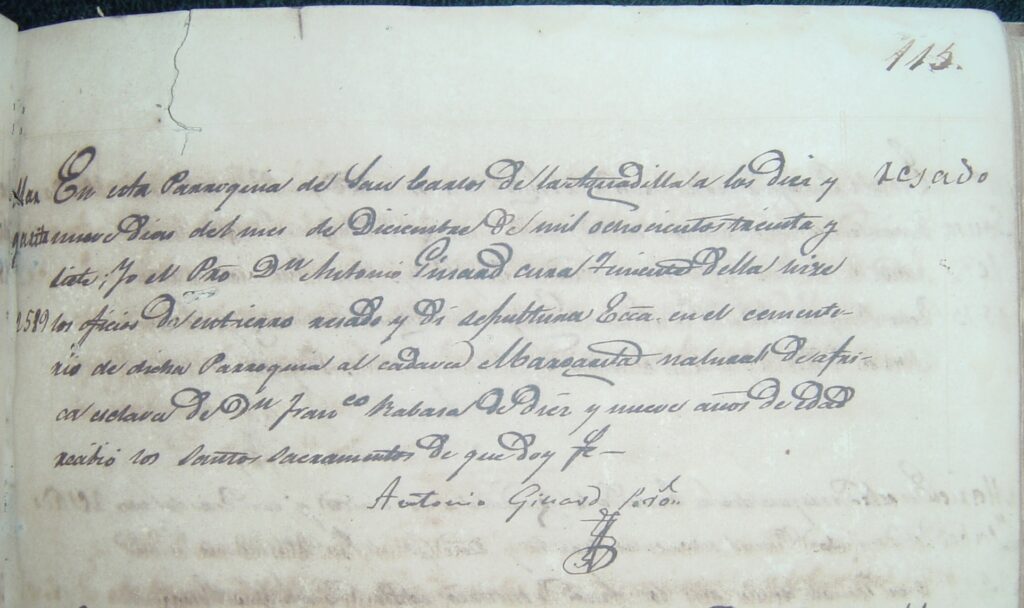
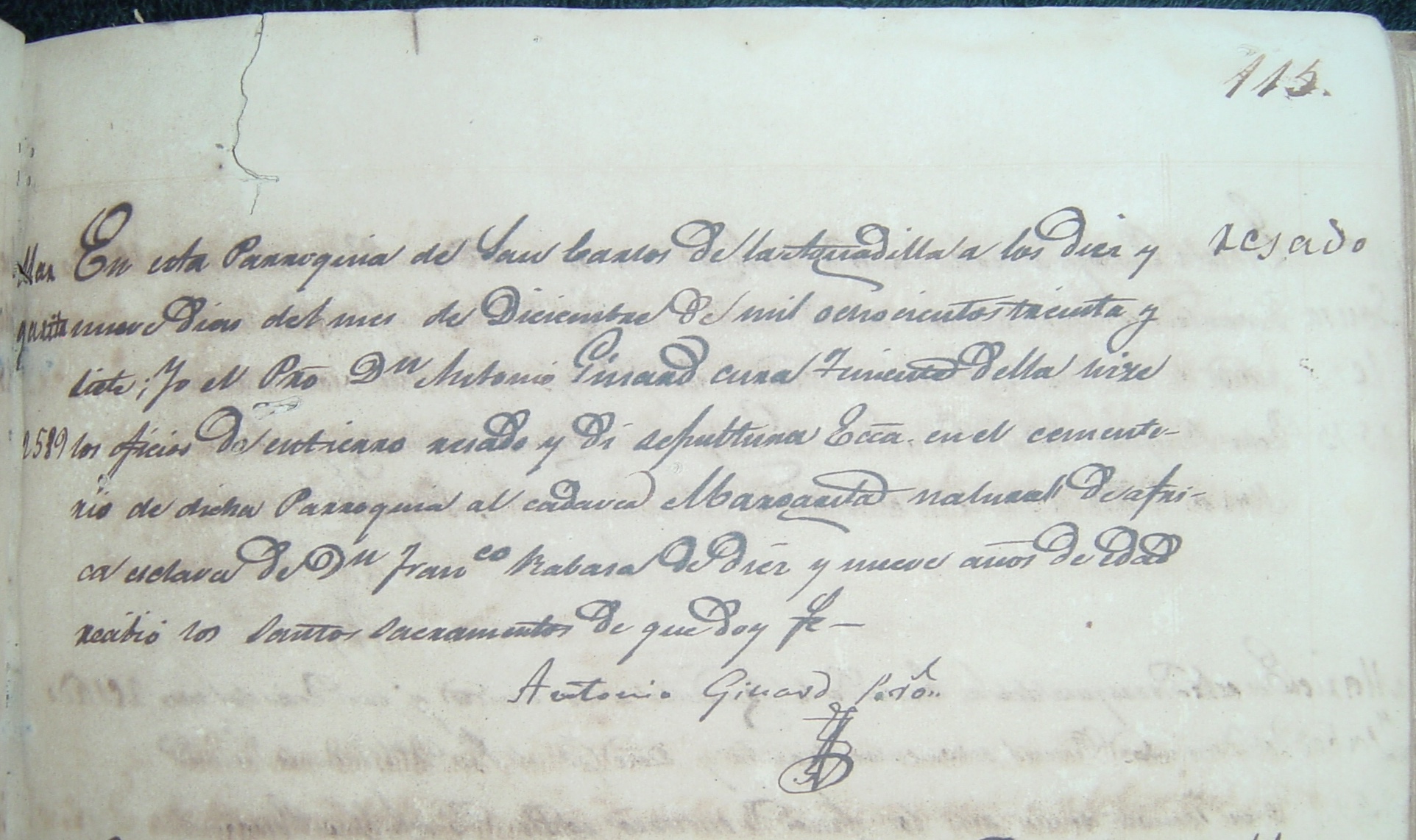
Margarita, death record Aguadilla, 1837

This post, based on transcriptions of a notary document from Aguadilla, speaks the names of several enslaved ancestors held in Aguadilla by Pedro Pellot. Pellot, one of four Peugeot siblings from Fuenterrabia (Hondarribia in Basque), Gipuzkoa, in the Basque Country of the Atlantic Pyrenees in Spain. The siblings arrived in Puerto Rico in 1804.[1]

By 1810, Pellot became a partner in the company of d. Pedro Abadia (Pedro Manuel Abadia Valencia ca 1727-1828) and d. Martin Lorenzo de Acevedo y Hernandez (1749-1828; also my 4th GGF). Pellot first administered, then purchased Abadia’s hacienda in Barrio Aceituna and expanded it, acquiring some 105 souls to work the coffee plantation by 1847.

While Hacienda Yruena, was among the three largest haciendas in Aceitunas, Pellot held the largest number of enslaved people in the municipality. He sold the property to its administrator, Juan Labadie Larre. The big house was rebuilt in 1903, and today is known as Hacienda Labadie. [2]

Hacienda Labadie, Moca, PR. E. Fernandez-Sacco, 2007. This version of the house was built in 1903.

Margarita

At the end of December 1822, d. Pedro Pellot purchased Margarita (bca. 1806), a young 16 year old woman, born in Guinea from Da. Maria Lucia Domenech Arze (1792-1832). [3] Maria Lucia also came from a family of enslavers, as at least one enslaved person held by her father d. Jose Domenech, appears in the first Libro de Defunciones for Aguadilla.[4]

Maria Lucia Domenech was the wife of d. Francisco Rabasa Dalmaso, a Catalan who settled in Aguadilla and whom she married three years earlier. Rabasa was also involved in buying and selling humans in the 1820s. Domenech made the sale on the basis of her rights under marriage to conduct business, and eventually, Margarita became the property of Pedro Pellot.

We come to know of Margarita’s life in Puerto Rico as part of a series of transactions. How accurate was the recording of her age? How many Margaritas were there on the Pellot plantation? This is an issue one faces when researching enslaved ancestors, as the focus on familial details is reserved for the enslaver, while personal details are used to maintain the status of the enslaved as property, and later in the century, after 1868, they became citizens incrementally.

Searching for Margarita

Acta entierro, “Margarita esclava de Dn. Fran.co Rabasa de diez y nueve anos de edad” 15 December 1837, APSCB Libro 6 F115 No, 2589

In Libro 6, F115 #2589 of entierros for San Carlos de la Aguadilla is a record for another Margarita, born about 1818.  On 19 December 1837, she was buried at the age of 19 years. According to the entry she was also enslaved by d. Francisco Rabasa. As Margarita (b.ca 1806) from the 1822 sale does not appear among the cedulas of 1868-70 in Caja 4 of the Registro de Esclavos, she either managed to buy her freedom, was sold away, or died. The difference in age, together with the children born after 1837 suggests that Margarita survived, unless the children belonged to a different Margarita.

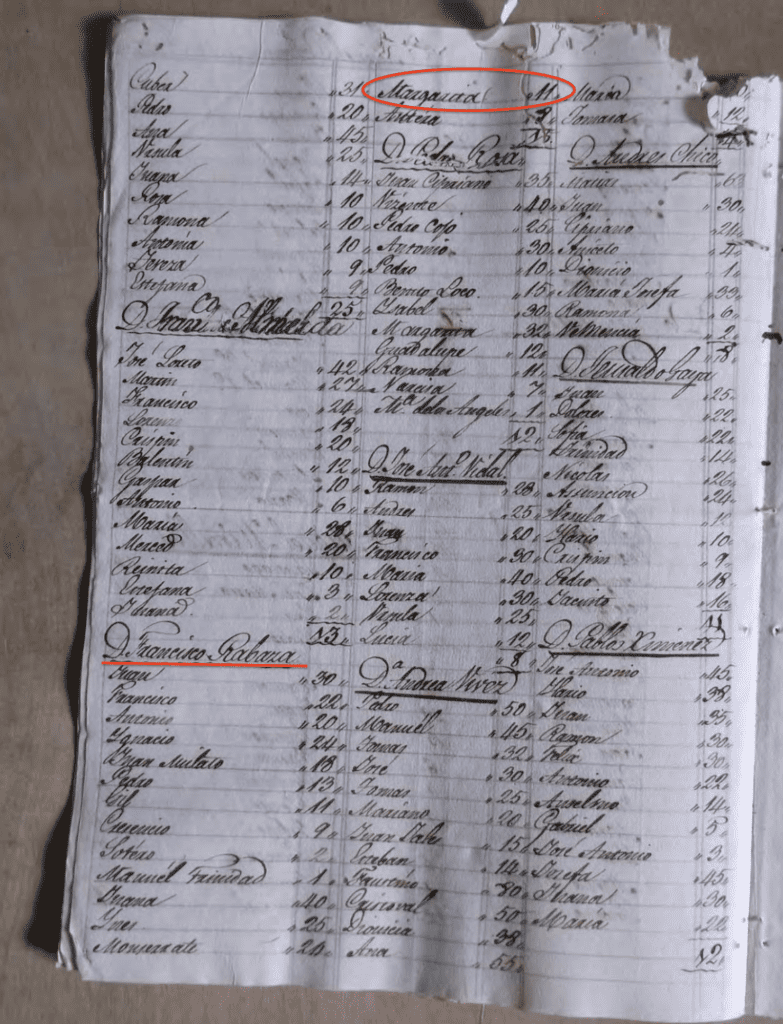
Other persons enslaved by Rabasa were born in Africa, such as Maria who died in 1828 (without noting her age or any other details), and Juana Rita 28, who died in 1843.  The 1826 Relacion de Esclavos de Aguadilla has a list of enslaved people held by d. Francisco Rabasa. At the top of the second column appears yet another Margarita, age 11 bca. 1815.

Enslaved persons held by Francisco Rabasa, Resumen de Esclavos, Aguadilla, Caja 62, 1826 AGPR
Caja 62, Relacion de Esclavos, d. Francisco Rabasa, 1826. AGPR

Another Set of Sales: Four Boys, Aguadilla, 1822

Four boys trade hands in Aguadilla in March 1822. While we have the record for Pellot’s purchase, there are another set of entries that offer the outlines of trafficking in small numbers of those enslaved. 

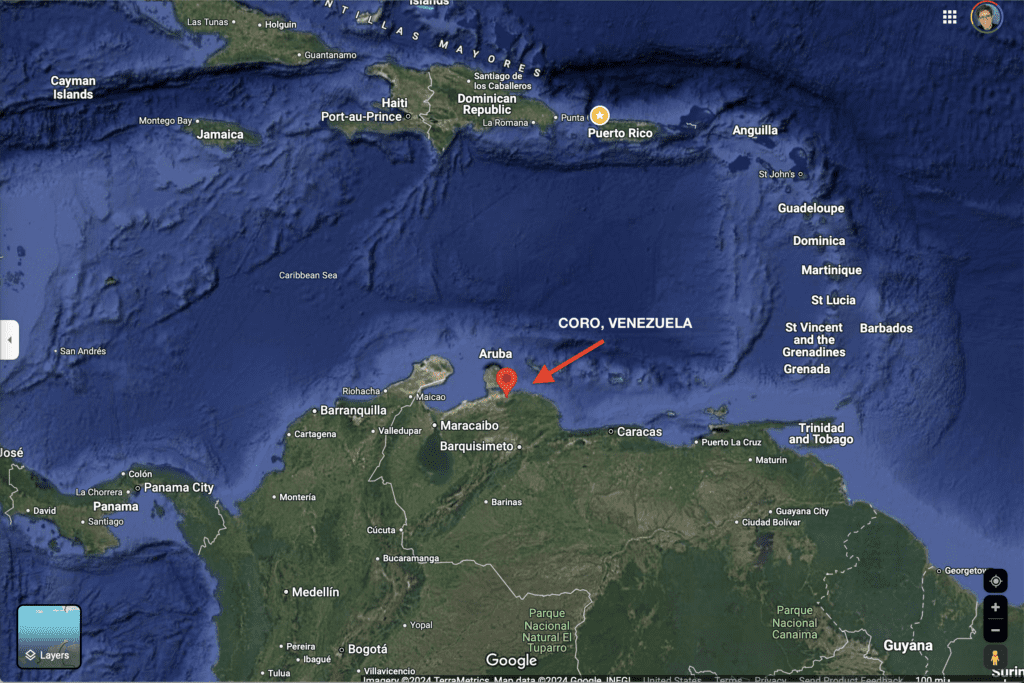
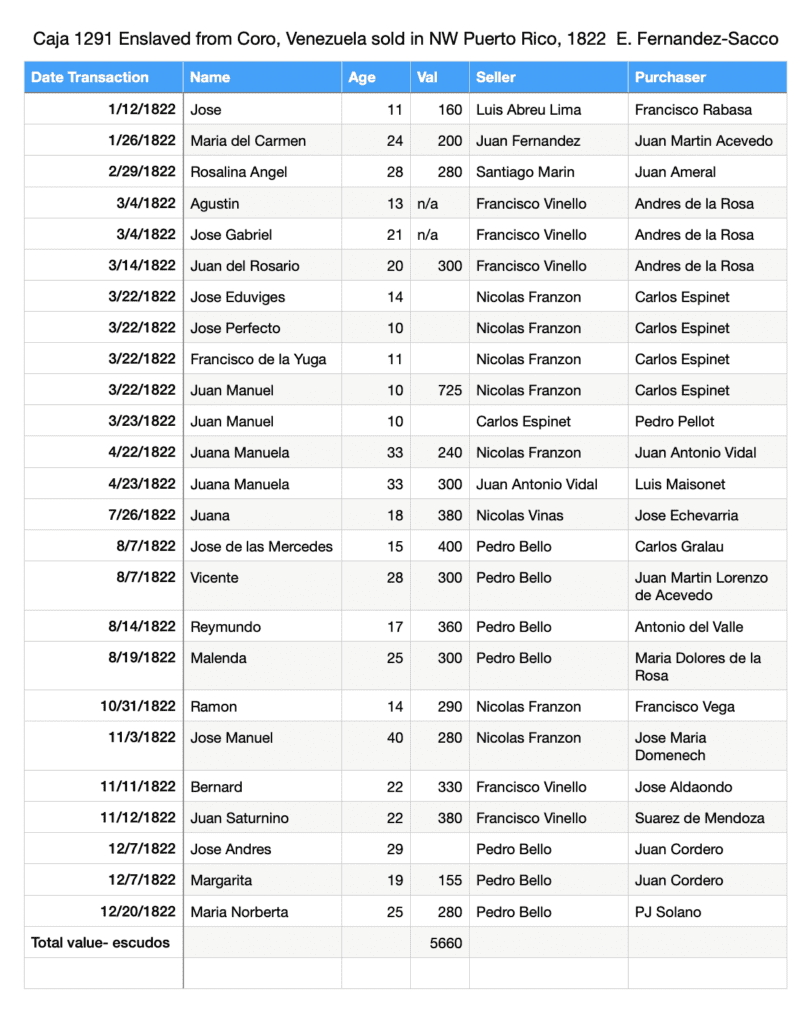
In March 1822, Pellot purchased four enslaved children born in Coro, Venezuela from D. Jose Antonio Vidal and D. Carlos Espinet. The boys were between the ages of 10 and 14, and worked as house servants. A host of questions come up– where were their mother or parents?  Were they separated earlier? When did they gain their freedom? Did they ever and when? What surname did they take on? Over how many continents did their origin reach? They are:

José Eduviges de 14 años, b, 1808

José Perfecto de 10 años, b.1812

Francisco de la Yuga de 11 años b.1811

José Manuel de 10 años b. 1812 [4]

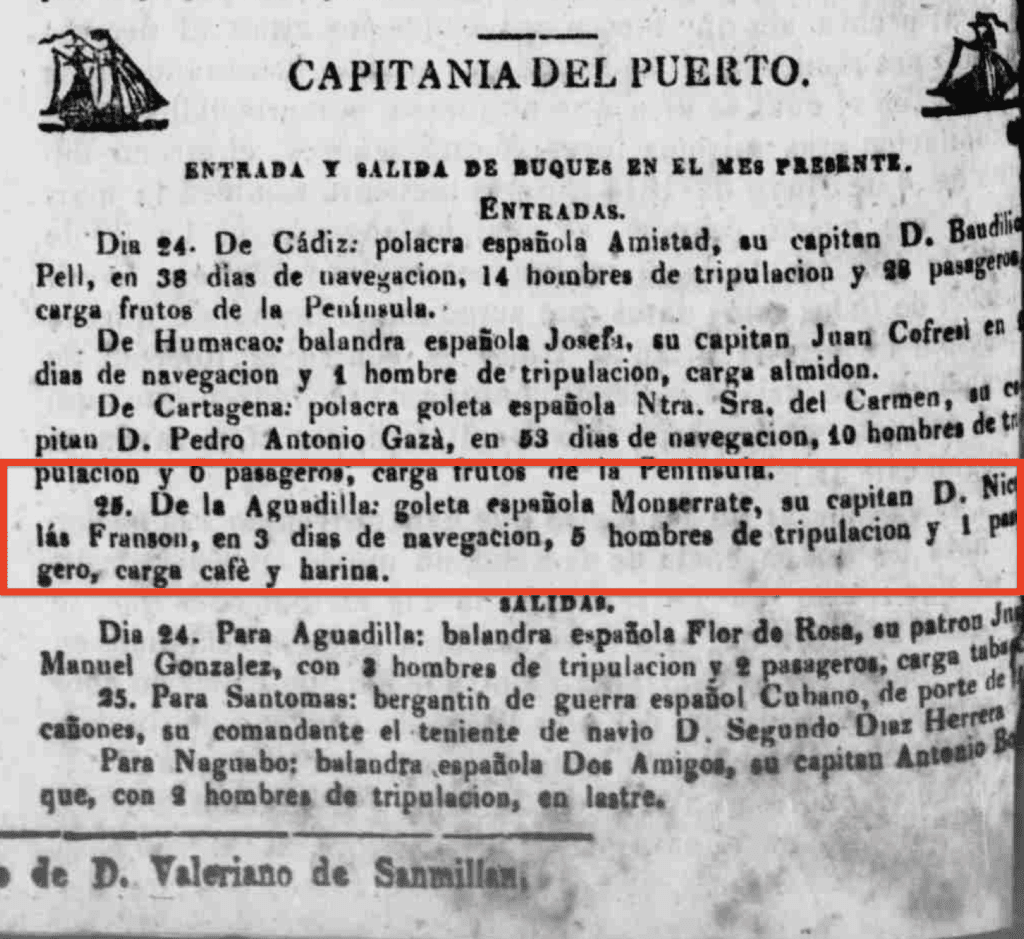
As the century wore on, there was a growing preference for purchasing children, with the expectation of a longer term of labor. [5] According to the entry, they were first sold as a group for 725 pesos by Nicolas Franson (b. Genoa, Italy) to Jose Antonio Vidal and Carlos Espinet.  The price that Pellot paid is not recorded in their resale on the 23 March 1822. [6] Franson was a captain, specifically of the ship Monserrate, ‘goleta espanola’, a two masted schooner, that suggests he was also capable of transporting the enslaved. I am left with questions and the hope of finding something more.

Capitania del Puerto, Gazette de Puerto Rico, Apr 29, 1837
Capitania del Puerto, – “25 Abril 1837, De la Aguadilla goleta española Monserrate, su capitán d. Nicolas Franson” Gazette de Puerto Rico, Apr 29, 1837. Library of Congress.

The witnesses to the sale were D.Francisco Rabasa, D.Juan Bautista Doumeng and D.Jose Joaquín Miranda, all local plantation owners and enslavers. These documents show the small scale of human trafficking among married couples, emigres who shared French or Basque origins and local partnerships. By 1850, more formal businesses were involved. 

Trafficking from Coro to Aguadilla, 1822

Here are all of the enslaved persons from Coro who were trafficked in Aguadilla for the year of 1822

Chart- Caja 1291 Enslaved from Coro Venezuela
Chart listing enslaved from Coro, Venezulela to NWPR, Caja 1291, Aguadilla.

References

[1] Ellen Fernandez-Sacco, “Reconstructing District 3’s Missing 1872 Registro Central de Esclavos for Northwest Puerto Rico.” [Part 1 of 4] Hereditas 2019, 73. Antonio Nieves Méndez, Historia de un pueblo: Moca 1772-2000. Ediciones Aymaco, lulu.com 2008, 247.

[2] Nieves Mendez,  Historia de un pueblo: Moca 1772-2000., 247.

[3] Caja 1291 En Aguadilla 3-22-1822 fol 128 ante mi,el escribano Real y público y testigos que se nominaran compareció  D.Nicolás Franson de este vecindario y dijo que da en venta Real a D.José Antonio Vidal y a Carlos Espinet de la propia vecindad 4 esclavos de su propiedad nombrados José Eduviges de 14 años, José Perfecto de 10 años, Francisco de la Yuga 11 años y José Manuel de 10 años naturales del Coro y se los vende por la suma de 725 pesos. Testigos y vecinos lo fueron D.Francisco Rabasa, D.Juan Bautista Doumeng y D.José Joaquín Miranda.  Instituto de Cultura Puertorriquena, AGPR, Fondo de Protocolo Notariales, Caja 1291, Serie- Aguadilla, Pueblo- Aguadilla, Escribano Jesualdo Gaya 1821-1822. Transcrito por Carlos Encarnacion Navarro.     

[4] Caja 1291 f370v-372, 31 Dec 1822; f131v – 132v, 23 March 1822

[5] According to Perez Vega, when the port of Ponce was opened in 1812, the port facilitated the direct arrival of free and enslaved people. For more on the traffic in children see Ivette Perez Vega’s “El trafico de ninos esclavos en el sur de PR, Ponce (1815-1830).” https://publications.iai.spk-berlin.de/servlets/MCRFileNodeServlet/Document_derivate_00001299/BIA_103_025_049.pdf

[6] Caja 1291, En Aguadilla 3-23-1822  fol.131-v a 132-v  ante mi, escribano Real y público y testigos que se nominaran comparecieron D. José Antonio Vidal y D. Carlos Espinet de este vecindario y dijeron que daban en venta Real a D.Pedro Pellot del mismo vecindario  4 siervos esclavos nombrados José Eduviges de   14 años, José Perfecto de 10 años, Francisco de la Yuga de 11 años y José Manuel de 10 años todos naturales del coro. Testigos y vecinos lo fueron D.Francisco Rabasa, D.Juan Bautista Doumeng y D.Jose Joaquín Miranda.

Citation: Ellen Fernandez-Sacco, “Remembering enslaved ancestors purchased by Pedro Pellot, Aguadilla, 1822.” Latino Genealogy and Beyond, 9 Nov 2024.